
Choosing the right digital marketing agency in India is harder than it should be. The country has thousands of agencies, by most industry estimates, several thousand active firms across metros and tier-2 cities, and nearly every one of them leads with the same pitch: higher rankings, better leads, stronger ROI. The more you search, the more confusing the decision becomes. That is not a coincidence. It is the nature of a market where supply has dramatically outpaced genuine differentiation, leaving you to sift through near-identical pitches with no clear way to tell them apart.
Here is the uncomfortable truth: the agency you choose will either compound your growth or quietly drain your budget, and you often will not know which is happening until months have passed. A poor fit does not always announce itself loudly. It shows up as stagnant traffic reports, vague explanations for missed targets, and a growing sense that you are paying for activity rather than outcomes.
What this article gives you is a framework, not a ranking. You will leave with a 7-point checklist, concrete pricing benchmarks, and the right questions to ask before signing anything. The digital marketing agencies in India worth your time in 2026 are the ones rebuilding their operations around AI at every layer, and you will know exactly how to spot them.
Why the agency market in India is harder to navigate than it looks
Open any shortlist of top digital marketing firms in India and count how many times you see the phrases “data-driven,” “results-focused,” and “growth partner.” The answer is: almost all of them. When surface language is identical across hundreds of firms, surface-level comparisons become useless, and buyers default to two poor proxies: price and word-of-mouth. Neither reliably predicts performance.
The more meaningful gap is between “promotional proof” and independently verifiable case studies. An agency that shows a results page with “increased traffic by 200%” is giving you a number without a baseline, a time period, or a channel breakdown. That is promotional proof. Contrast that with documented outcomes, such as a 493% conversion lift, a 140% increase in purchases, and a 702% increase in conversion value across a defined campaign window, figures drawn from published agency case studies, and you start to see what real proof looks like. That is the standard you should hold every agency to before shortlisting them.
The industry has also bifurcated sharply in 2026. On one side are traditional agencies running manual campaigns with templated monthly reports. On the other are agencies that have rebuilt their operational model around AI, predictive analytics, and real-time optimisation. Directional evidence from industry research suggests the performance gap between these two types is widening, and your selection criteria need to reflect that reality.
How to evaluate a digital marketing agency in India: the service stack
The first question to answer is whether you need a specialist or a full-service partner. A specialist PPC agency or SEO firm can go deep on a single channel, which makes sense if you already have strong in-house capability everywhere else. For most businesses, though, a full-service digital marketing agency in India is the stronger fit. SEO, paid media, content, and conversion rate optimisation produce compounding results when they work together; siloed specialists who do not communicate produce inconsistent ones.
A credible full-service agency should cover the following at minimum, not at a checkbox level, but with genuine depth:
- Technical, on-page, and off-page SEO
- Google Ads and Meta Ads management with active bid optimisation
- Social media and SEO services tailored to Indian audiences, with audience targeting and creative testing
- Content creation tied to a documented strategy
- Email marketing with segmentation and personalisation
- Conversion rate optimisation across landing pages and user journeys
Beyond these, the question that now separates serious digital marketing companies in India from pretenders is where AI sits in their workflow. An agency using AI only for copywriting is fundamentally different from one that uses machine learning for audience modelling, automated budget reallocation across campaigns, and predictive analytics for forward-looking reporting. Ask the question directly: where exactly does AI sit in this agency’s day-to-day operation?
How pricing models actually work (and what to budget)
Most Indian digital marketing agencies operate on monthly retainers, with project-based fees for one-off work and performance incentives layered on top of a base fee rather than used as a standalone model. Performance-only arrangements are rare in practice. What you are more likely to encounter is a base retainer plus a bonus structure tied to agreed targets, or a percentage of ad spend above a defined threshold.
For concrete planning, here are realistic pricing bands by business size in 2026:
- SMBs: ₹25,000, ₹75,000 per month for multi-channel management
- Upper-SMB and emerging mid-market: ₹75,000, ₹1,50,000 per month
- Mid-market (integrated strategy, media, creative, and analytics): ₹1,50,000, ₹3,00,000+ per month for standard integrated programmes; full-service mid-market retainers with deeper creative and analytics can range higher
- One-off projects such as SEO audits, campaign setup, or website builds: ₹15,000, ₹1,00,000+ depending on scope
One practical consideration worth noting: agencies based in India typically offer significantly lower retainer costs than their US or UK counterparts for comparable scope, which means Indian businesses can access AI-powered, full-service execution at budget levels that would barely cover a single channel manager in a Western market. Ask for scope breakdowns to make that comparison directly.
Watch for these red flags in pricing conversations:
- Agencies that refuse to separate deliverables from fees
- Those who quote ad spend management percentages without clarifying what is included
- Those with no minimum contract transparency
A trustworthy agency will tell you exactly what is in scope and what costs extra before you sign anything.
AI capabilities: the new benchmark for digital marketing agencies in India
AI in marketing has moved well past novelty for any agency serious about performance. Agencies not using AI for campaign optimisation, audience modelling, and reporting operate with structurally slower feedback loops, and their clients pay for that delay in missed conversions and wasted ad spend. The difference is visible in response times, reporting granularity, and how quickly a campaign course-corrects when performance dips.
Genuine AI integration looks like this in practice: real-time budget reallocation across ad platforms based on live performance signals, and generative AI paired with human creative direction rather than replacing it. That combination feeds into predictive analytics that show you where a campaign is heading rather than just where it has been, supported by AI-assisted CRO that continuously tests landing pages and user journeys without waiting for a monthly review cycle.
OnlinEmage is built around this model. As an AI-first digital marketing agency, OnlinEmage has embedded AI across every service layer, SEO strategy, paid media optimisation, content creation, reputation monitoring, and email personalisation, operating on a connected AI-powered backbone rather than a collection of disconnected tools. For businesses evaluating best digital agencies in India, that level of integration is worth probing directly in any agency conversation.
To verify any agency’s AI claims, give them a practical test. Ask them to explain, in plain language, exactly which tools are AI-powered, what decisions those tools automate versus what a human reviews, and how AI-generated insights feed back into campaign changes. Vague answers reveal surface-level adoption. Specific, detailed answers reveal genuine integration. The difference is easy to hear once you know what you are listening for.
What to ask about AI tools specifically
Push beyond brochure language. Ask which platforms they use for automated bidding, how audience signals feed into creative decisions, and whether their reporting dashboards update in real time or on a lag. An agency with genuine AI capability will answer these questions without hesitation and offer to show you a live example.
A 7-point checklist to evaluate any agency before you commit
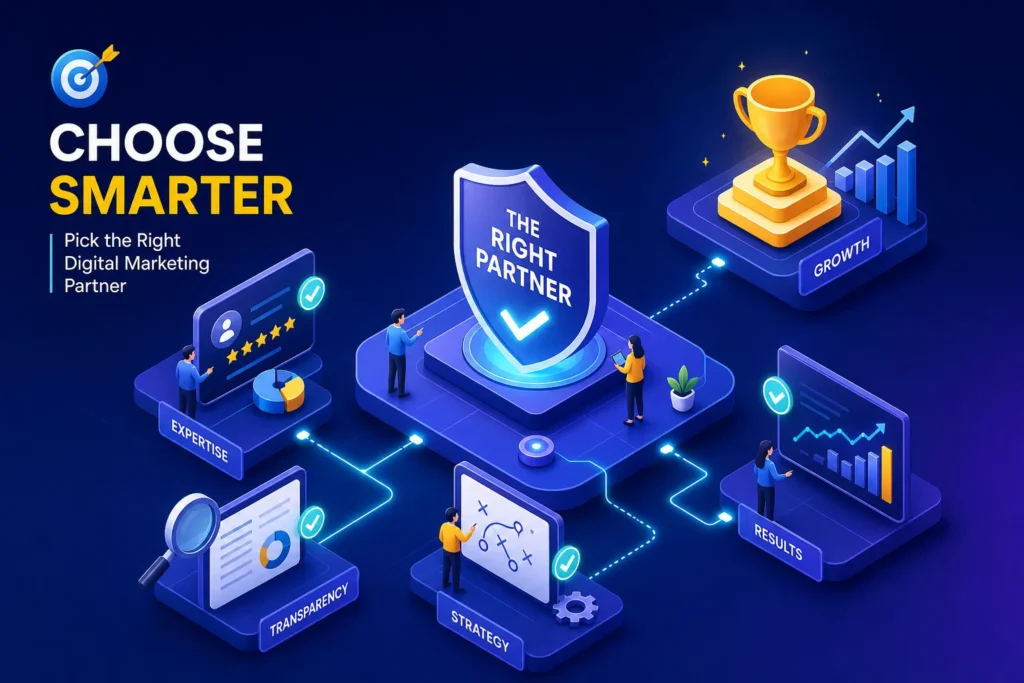
Use this checklist as a decision tool, not a scoring grid. The weight of each point depends on your business stage and growth goals, but none of these points is optional for a serious evaluation.
1. Verified case studies with baselines, channel breakdowns, time periods, and final numbers. A results page without a baseline is not a case study; it is a headline. Ask for the before, the after, the time frame, and the specific channels involved. Shortlisted agencies should be able to produce at least two examples relevant to your sector.
2. Industry-relevant experience that maps to your sector and your audience. An agency with a strong track record in e-commerce is not automatically the right fit for a B2B services firm. Ask specifically about work in your vertical.
3. Third-party credibility such as Clutch reviews, Google ratings, Google Partner or Meta Business Partner status, and relevant platform certifications across Search, Display, Video, and Analytics. These signals do not guarantee quality, but their absence is a warning sign. Also consider recognised professional certifications when evaluating claims about skills and training, for example a formal digital marketing certification from established bodies.
4. Defined KPIs upfront, named before onboarding begins. Agencies that cannot specify your success metrics in the first conversation are making it up as they go. Your KPIs should include both performance metrics (ROAS, CPA, conversion rate) and business outcome metrics (revenue, qualified leads, LTV). For guidance on practical metrics to track, see resources on best KPIs for marketing agencies.
5. Transparent reporting, meaning you own the data, you have direct access to ad accounts and dashboards, and you receive reports on a defined schedule. An agency that keeps you locked out of your own accounts is protecting their position, not yours.
6. Strategic thinking demonstrated in the sales process. Does the agency diagnose your specific problem before pitching a package, or do they arrive with a slide deck that could apply to any client? The quality of thinking in the sales process is a reliable preview of the quality of thinking in the work itself.
7. AI and technology capabilities verified through specific questions, not brochure claims. Ask exactly which parts of the workflow are AI-powered, how those tools connect, and where human judgement overrides automated decisions.
Questions to ask before you sign any contract
The right questions do not just surface information, they reveal how an agency thinks. Start with questions that test expertise:
- “Can you walk me through a case study from our industry, including the baseline, what you changed, and the outcome over a specific time period?”
- “What KPIs will define success for our account in the first 90 days?”
- “Who manages our account day to day, and what is their experience level?”
Agencies that think in outcomes will answer these fluently. Agencies that think in outputs will stall or reach for generalities.
Follow with questions about process and accountability:
- “What access will we have to our ad accounts, analytics dashboards, and content calendars?”
- “What does your onboarding process look like, and how long before we see initial results?”
- “How do you course-correct when a campaign underperforms mid-flight?”
These answers reveal whether the agency runs a structured, accountable operation or improvises its way through client work. A structured agency will give you a specific answer for all three. An improvising agency will use the phrase “it depends” more than once without following it with a framework.
One final filter is worth adding to your process: give each shortlisted agency the same one-page business problem and ask for a brief strategic response within a few days. Compare how well each agency diagnoses the core issue, proposes a measurable plan, and explains their reasoning. This practical test separates agencies that can execute from those that can only sell, and it does so before you have committed a single rupee.
Conclusion: where the right agency search ends
The Indian digital marketing market is not short of agencies. It is short of frameworks for telling them apart. The 7-point checklist, the pricing benchmarks, and the AI capability questions in this guide give you a structured way to cut through identical-sounding pitches and find a digital marketing agency in India that can actually move the needle on your business.
The shift worth watching in 2026 is the move from agencies that use AI as a feature to agencies that have rebuilt their entire operation around it. That shift is visible if you know what questions to ask. Start your shortlist with agencies that can answer everything in the questions section without hesitation, show you verified case studies with hard numbers and clear baselines, and explain precisely how AI sits inside every layer of their campaign workflow. You can begin by checking curated lists of digital marketing firms that specialise in India to compare capabilities and approach before you shortlist them (digital marketing agencies in India).
If you want to see what that standard looks like in practice, OnlinEmage is a useful reference point. OnlinEmage was designed from the ground up as an AI-first digital marketing agency, built to deliver predictive analytics, real-time optimisation, and AI-powered creative across every service simultaneously. That is where the right search for a digital marketing agency in India ends: not with the agency that promises the most, but with the one that can prove it most clearly.
