
Most Indian brands shortlist a Google Ads agency in India the same way they shortlist a vendor for office furniture: they get three quotes, check for a recognisable badge, and go with whoever sounds most confident in the pitch. Six months later, the campaign dashboard shows impressions and clicks, the agency sends a colourful PDF, and someone in the room quietly wonders why leads aren’t coming in. The process felt rigorous. The outcome wasn’t.
The real problem isn’t price or even the Google Partner badge on the homepage. It’s that most shortlisting criteria measure what an agency looks like rather than how it actually works. In 2026, the operational gap between a manual PPC management company and an AI-first agency has grown wide enough to materially change business outcomes. One is adjusting bids a few times a week and writing periodic reports. The other is running predictive bidding logic across thousands of signals in real time, reallocating budget dynamically, and feeding conversion data back into the algorithm continuously. These are not variations on the same service. They are fundamentally different products.
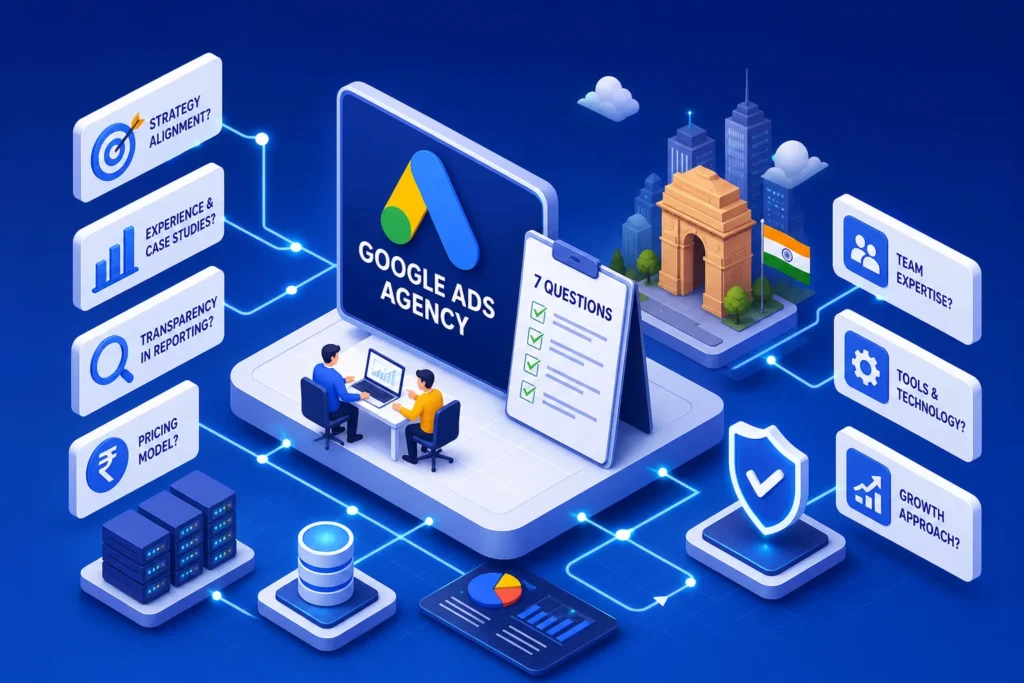
The seven questions below are designed to cut through the sales deck and expose how an agency actually operates. Use them before you sign anything.
Why most Indian brands end up with the wrong Google Ads agency
The default shortlisting criteria, proximity, price, and a Google Partner badge, are not useless. They are just measuring the wrong things. A Google Partner certification tells you an agency has met Google’s minimum spend threshold (USD 10,000 in 90-day managed spend), maintains a 70% optimisation score, and has at least half its account strategists certified. Those are baseline hygiene requirements, not performance indicators. An agency can hold Partner status and still be running Search campaigns on manual CPC bidding with keyword match types from 2019.
Google Premier Partner status is more meaningful. It places an agency in the top 3% of participating companies within India, evaluated annually on client growth, retention, product diversification, and ad spend. Verification matters here: don’t take the badge at face value. Use Google’s official agency finder to confirm status independently. Premier Partner signals operational scale and account diversity, but it still doesn’t tell you whether the agency is running Performance Max campaigns, using Smart Bidding correctly, or setting up conversion tracking before a campaign goes live.
The single most consequential question you can ask a prospective PPC agency in India is this: what bidding strategy do you default to, and why? If the answer is vague, or if manual CPC features prominently without a strong rationale, you have your answer about their operational philosophy. Google’s bidding and budgeting guidance emphasises automation where sufficient conversion data exists. Smart Bidding processes conversion signals at a scale no human manager can replicate across a full account. Performance Max runs across Search, Display, YouTube, Discover, and Gmail simultaneously, optimising in real time. These are not premium features reserved for large budgets. They are the baseline in 2026.
What a full-service Google Ads management agency in India should actually deliver
A genuinely capable agency at this scope should cover Search, Display, Performance Max, Shopping, YouTube, and remarketing as part of a coherent multi-channel strategy, not as upsells, and not as optional add-ons for enterprise clients. Each campaign type serves a distinct function in the conversion funnel, and a good agency understands which combination suits your business model, your customer acquisition cost, and your growth stage.
Performance Max deserves particular scrutiny. Any agency that isn’t running PMax campaigns for eligible clients in 2026 is leaving significant reach and conversion efficiency on the table. PMax uses automated Smart Bidding exclusively and optimises across all Google inventory from a single campaign. The nuance is in how asset groups are structured and how target ROAS or CPA goals are set: too aggressive a target and the algorithm restricts delivery; too loose and spend efficiency drops. An agency that can walk you through that calibration process in plain language understands the product. One that defaults to “we’re monitoring it” probably doesn’t.
The measurement layer is where many agencies quietly fail. Conversion tracking must be set up and verified before a campaign goes live, not retrofitted six weeks in. Google Analytics 4 integration, attribution modelling, and a reporting framework that connects ad spend to actual business outcomes, pipeline, revenue, or qualified leads, are not optional extras. They are the foundation on which Smart Bidding trains. If the tracking data is inaccurate or incomplete, the algorithm learns from bad signals and accumulates errors over time. Poor measurement isn’t just a reporting inconvenience; it structurally undermines campaign performance.
How to read certifications and case studies critically
When an agency shows you a case study, apply a simple test: does it name the industry vertical, state the starting benchmark, describe the specific intervention, and show the measured outcome? A case study that says “we improved ROI for a retail client” is a marketing statement. A case study that says “we reduced CPA from ₹1,800 to ₹940 for a D2C skincare brand over six months by restructuring Shopping campaigns and enabling Smart Bidding with a verified GA4 conversion action” is evidence. The difference matters because the second version tells you the agency understands the mechanism, not just the result.
Published 2026 industry benchmarks offer a useful reference point when evaluating those claimed results. Search conversion rates average around 4.40% across industries, with e-commerce typically sitting in the 2.69, 2.81% range and legal or consumer services reaching above 6%. Average CPA on Search runs roughly $45, $116 depending on vertical, with B2B and legal at the higher end and automotive at the lower end. Indian market rates are typically lower in absolute rupee terms due to lower auction competition in most categories, so an agency claiming dramatic improvements in a low-competition vertical should be probed further. Ask what the benchmark was before the engagement started.
Pricing models and what to watch for in contracts
Three pricing models dominate the Indian Google Ads agency market. A percentage of ad spend (typically 15, 20%) is common, though it can create perverse incentives to increase spend regardless of efficiency. A flat monthly retainer runs roughly ₹25,000 to ₹1,25,000 per month for small brands, ₹1,25,000 to ₹4,00,000 for mid-market accounts, and ₹4,00,000 upward for enterprise scope with advanced analytics and a dedicated senior resource. Hybrid pricing combines a base retainer with a percentage above a spend threshold, which aligns incentives better as budgets scale. The right model depends on your business size and spend level, but any agency pushing for a long lock-in without a performance exit clause is not confident in its own results.
Contracts deserve careful review before you sign. The red flags that matter most are structural, not cosmetic. If the agency owns or controls your Google Ads account rather than holding manager-level access while you retain admin rights, you lose all leverage the moment the relationship sours.
Other warning signs include vague deliverables (“best efforts,” “regular updates”), opaque reporting with no agreed dashboard or cadence, agency-owned creative assets that aren’t transferable on exit, and auto-renewal clauses with long notice periods. These are not minor legal details. They are the mechanisms through which an underperforming agency can continue extracting a retainer long after it’s clear the relationship isn’t working.
A clean contract specifies scope, reporting frequency, the exact fee structure including setup and software costs, client ownership of the account and all data from day one, and a clear termination process with asset transfer on exit. Insist on these before you engage anyone.
The 7 questions to ask before hiring any Google Ads agency in India
These questions are diagnostic tools. They reveal operational reality rather than sales positioning. The answers will tell you more than any credentials page.
Questions 1 to 4: capabilities, AI, and account structure
Question 1: What bidding strategy do you default to for a new Search campaign, and what would change that decision? A strong answer references Smart Bidding (Maximise Conversions, Target CPA, or Target ROAS depending on conversion volume), explains the data thresholds needed for each, and describes how manual CPC might be used briefly during the learning phase. A vague answer about “testing different approaches” is a warning sign.
Question 2: Do you run Performance Max campaigns, and how do you structure asset groups? The answer should include specifics about audience signals, asset group segmentation by product or service category, and how they monitor PMax’s impact on existing Search campaigns. If the agency hasn’t run PMax recently or can’t explain asset group logic, that’s a gap.
Question 3: Who owns the Google Ads account, and will I have admin access from day one? The correct answer is: you own it, the agency gets manager access. No further discussion required.
Question 4: How do you set up and verify conversion tracking before campaigns launch? Look for a specific answer: GA4 integration, tag verification via Google Tag Assistant, and confirmation that the bidding algorithm is receiving accurate conversion data. “We set it up in the first week” is not a complete answer.
Questions 5 to 7: reporting, pricing transparency, and case study validation
Question 5: Can you show me a sample report? Check whether it connects ad spend to business outcomes, qualified leads, revenue, or pipeline, rather than stopping at clicks, impressions, and CTR. A report that doesn’t tie back to commercial results is not a management report; it’s a vanity dashboard. The standard to hold any agency to is reporting that surfaces predictive insights, not just a backward-looking summary of what already happened.
Question 6: What’s the full fee breakdown, including setup charges, software costs, and what happens to assets if we stop working together? Any hesitation or vagueness here is meaningful. A confident agency with nothing to hide will answer this in two minutes.
Question 7: Can you show me a case study from my specific industry vertical, with named metrics and an available contact reference? This is the filter that separates agencies that have genuinely done the work from those that have repurposed generic results. If the case study can’t name a CPA, ROAS, or conversion rate improvement with a starting benchmark, it isn’t a case study; it’s a testimonial.
Choose the Google Ads agency in India that earns its retainer before asking for it
The right Google Ads partner in India is not the cheapest one, nor the one with the most polished credentials page. It’s the one whose campaign intelligence, measurement discipline, and account transparency build on each other over time to produce returns that justify and exceed the fee. That combination is rarer than the market suggests, which is exactly why these seven questions matter.
For brands that want to skip the trial-and-error phase, OnlinEmage‘s AI-Optimised Pay Per Click Marketing approach operates on real-time budget reallocation, predictive Smart Bidding, full account transparency, and measurement infrastructure that connects spend directly to business outcomes. The seven questions above apply to any Google Ads agency India-based businesses are considering. If you want an agency that answers all seven with operational specificity rather than sales fluency, that’s the right place to start the conversation.
Run the checklist. How to Select the Best Digital Marketing Agency in India: Key Factors that earns its place before the contract is signed.
