
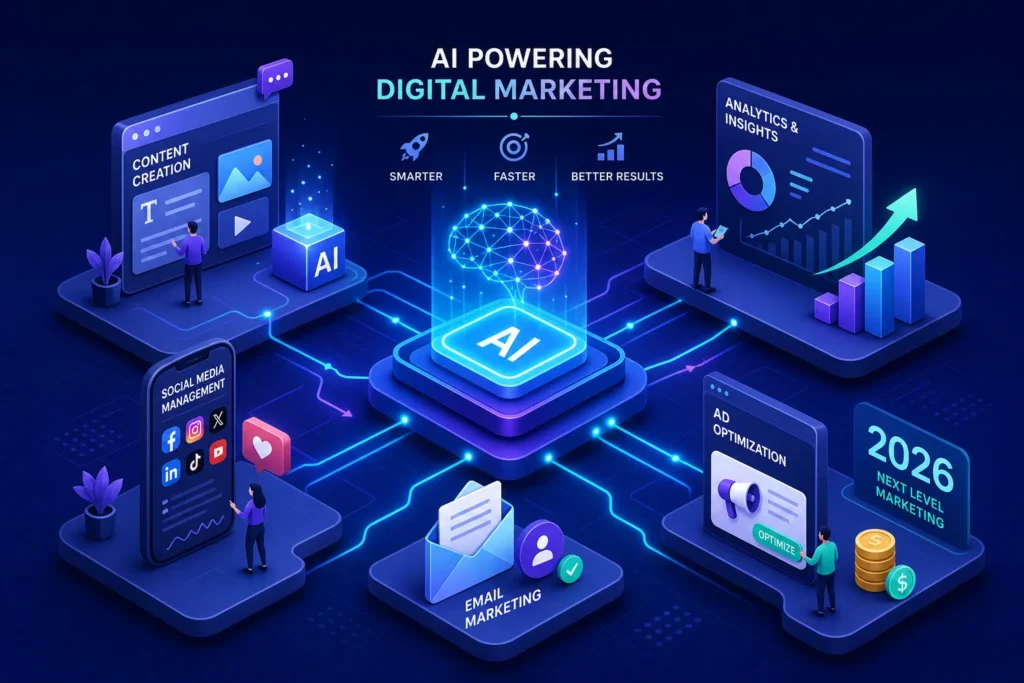
There is a peculiar paradox unfolding in marketing teams across India right now. Most marketers in 2026 have access to more AI tools for digital marketing than at any point in history, yet campaign performance has not improved proportionally. Budgets are still being wasted. Content still falls flat. Ad ROI remains stubbornly inconsistent. The problem is not a shortage of options, it is that most teams treat AI marketing tools like standalone gadgets rather than coordinated parts of a system.
Think of it this way: a tool is an ingredient, not a recipe. You can stock your kitchen with every appliance imaginable and still produce a forgettable meal if you do not understand how the elements work together. The brand mention belongs here, not as a contrast claim, but as context for what a genuinely coordinated approach produces. At OnlinEmage, the approach is not to accumulate subscriptions; it is to build a campaign architecture where every AI layer feeds the next, from content ideation through to real-time budget reallocation. That is what an AI-first system actually looks like in practice.
This guide covers the best AI tools for digital marketing by task in 2026, how to compare them, realistic pricing benchmarks (including rupee-equivalent estimates for Indian teams), and a clear plan for getting started within a week. The goal is not to hand you a shopping list. It is to help you think like a systems builder.
Why having more AI tools doesn’t automatically mean better marketing
Tool adoption and strategic clarity are two entirely separate disciplines. Most businesses are reasonably good at the first and surprisingly poor at the second. They subscribe to a dozen platforms, assign them to different team members, and wonder why the outputs feel disconnected. What they have built is a tool stack, simply a collection of subscriptions. What they needed was a campaign system: an architecture where tools communicate, share data, and compound results over time.
Isolated AI tools generate isolated outputs. When your content platform does not talk to your SEO tool, and your ad platform does not share signals with your analytics layer, the results are fragmented by design. A unified system looks different: shared data pipelines, aligned objectives, and tools selected for compatibility rather than popularity. The first question to ask before choosing any AI tool is not “what is the most powerful option?” It is “where exactly is my campaign losing momentum?”
What “AI-first” means in practical marketing terms
AI-first does not mean replacing marketers with algorithms. It means AI is embedded at every decision point in a campaign: from content ideation to audience targeting to budget reallocation. A concrete example is real-time budget shifting in paid advertising, where AI continuously moves spend toward the highest-performing audience segment mid-campaign without waiting for a weekly human review. That single capability can meaningfully improve ROAS without any additional creative investment.
This is the operational reality that distinguishes AI-first teams from teams that simply use AI marketing tools occasionally. For Indian businesses working with tighter margins and faster-moving consumer attention, the compounding advantage of an integrated stack is not a luxury, it is a competitive necessity.
AI tools for digital marketing: content creation and SEO
Content and SEO are no longer separate disciplines, and the best AI tools for digital marketing in 2026 reflect that integration. The most effective approach treats them as a pipeline: one tool shapes the strategic brief, another generates the draft, and a third scores it against live SERP data before publication. When this pipeline is working well, a marketer can move from keyword research to a ranked article in hours rather than days, and for a curated list of the best AI content marketing tools you can compare feature sets and use-cases before committing to a trial.
Generative AI tools for content production
Jasper AI remains one of the most capable AI content generators for long-form content, email sequences, and brand-aligned copy. Its brand voice training feature is particularly valuable for teams maintaining consistency across multiple channels. Pricing starts at approximately $49/month (roughly ₹4,100) for the Creator plan and $125/month (roughly ₹10,400) for the Teams plan, which supports three users with unlimited words. StoryChief complements Jasper well for teams that need centralised editorial calendar management and multi-channel distribution to platforms like LinkedIn and WordPress. Lumen5 rounds out the content stack for teams converting written content into video, requiring minimal production investment and making video output genuinely scalable.
AI-powered SEO and search visibility platforms
Surfer SEO’s real-time content scoring engine and SERP analysis capability make it the natural pairing with Jasper: Jasper writes, Surfer scores. Users have documented SEO score improvements of 27 points or more within a single editing session when applying Surfer’s NLP suggestions to a Jasper draft. Semrush, starting at $117/month (roughly ₹9,750), serves teams that need a broader strategic layer including topic discovery, competitor analysis, and AI search traffic attribution. Clearscope is the preferred choice for building topical authority over time, particularly for content agencies and in-house teams managing high-volume publishing.
One platform worth noting separately is OtterlyAI, which tracks brand visibility in AI-generated search results. This is an increasingly important capability as tools like Perplexity and ChatGPT reshape organic discovery, and for Indian brands investing in generative engine optimisation, it addresses a gap that traditional SEO platforms are only beginning to fill.
AI tools for digital marketing: ads and paid campaign management
AI ad platforms in 2026 do more than automate execution. The better ones eliminate guesswork at the creative and targeting stages, which is where most paid campaign budgets are quietly wasted. Each tool addresses a different stage of the campaign lifecycle, so the selection decision should start with whichever stage is currently underperforming.
Autonomous ad execution and budget optimisation tools
Albert AI operates as a fully autonomous cross-channel campaign manager, continuously reallocating budget across Google, Meta, and programmatic channels based on live performance signals rather than weekly human reviews. It is most effective for enterprise teams running direct-response campaigns with clear conversion events. Smartly.io takes a complementary approach, excelling at creative automation and social media buying across Meta, TikTok, and Snapchat. Its published results include a 27% average performance lift compared to static creatives, and a 40% reduction in cost per landing page view in one documented case study; see the Smartly.io resource on scaling ad performance. Albert handles the cross-channel intelligence; Smartly handles the creative volume. Used together, they cover the full paid campaign lifecycle far more effectively than either does alone.
AI tools for ad creative and copy testing
AdCreative.ai generates performance-optimised visuals and copy at scale, making it a strong fit for e-commerce and D2C brands that need high-volume creative output without a large production team. Phrasee uses emotional language modelling to test which phrasing variants drive higher click-through rates. In several published brand trials, CTR improvements have exceeded 100% when Phrasee’s recommendations replaced manually written copy, though results vary significantly by industry, audience size, and baseline creative quality. These are not incremental gains in the cases where they occur; they represent a fundamentally different way of approaching creative strategy, one that replaces intuition with live performance data.
AI tools for analytics, email, and CRM
Most teams prioritise content and ads tools first, which is understandable. But analytics and AI-powered CRM for marketing are what transform campaign data into compounding advantages. Without them, every new campaign starts from scratch. With them, each campaign teaches the system something that makes the next one smarter.
Behaviour analytics and brand intelligence tools
FullStory’s session replay capability reveals something that standard analytics dashboards consistently miss: the “why” behind user drop-off. Watching actual user journeys surfaces friction points that no metric alone can identify. Brand24 pairs well with FullStory by monitoring brand sentiment in real time, surfacing reputation risks before they escalate into visible problems. For agencies managing multiple client accounts, Alai replaces the manual process of compiling performance data into client decks, generating presentation-ready reports automatically. According to a 2024 Salesforce State of Marketing report, AI-assisted reporting tools can reduce time spent on writing and reporting tasks by as much as 70%, a meaningful operational saving for any team producing regular campaign documentation.
AI-enhanced email and lead management platforms
Klaviyo is the clearest choice for e-commerce brands; learn more about AI-Enhanced Email Marketing | Smarter Email Campaigns. Its predictive analytics, including customer lifetime value estimates, churn risk scores, and next order date predictions, update in real time and drive behavioural triggers that outperform standard campaign sends. Klaviyo’s own published data shows automated flows averaging a 2.11% placed order rate compared to 0.16% for standard campaigns. When AI-sourced traffic is paired with properly segmented Klaviyo sequences, conversion rates have been reported at 2.4x to 2.6x higher than traditional search traffic in e-commerce contexts. HubSpot AI serves teams that need CRM alignment across marketing, sales, and service in a single platform, making it the stronger choice for B2B or mixed-model businesses. ActiveCampaign, starting at $15/month (roughly ₹1,250), remains a practical option for SMBs running structured drip campaigns without enterprise-level complexity.
How to choose AI tools for digital marketing without wasting budget
The most common mistake in AI tool selection is matching tools to trends rather than to specific problems. Rather than following a rigid framework, the decision logic is straightforward: identify where your campaigns are genuinely losing momentum, shortlist tools built specifically for that gap, and check integration compatibility before committing to any subscription. Pricing context matters here too, because many Indian marketing teams over-invest in enterprise-tier tools before their workflows are ready for them.
Matching the right tool to your specific marketing bottleneck
Three practical scenarios illustrate this clearly. A brand struggling with content output should prioritise Jasper paired with Surfer SEO. A brand with strong content but weak ad ROI should evaluate Albert AI or Smartly.io. A brand generating reasonable traffic but seeing low conversions needs FullStory to diagnose the problem and Klaviyo to fix the follow-up; for documented examples of uplift, see conversion rate optimisation case studies. This scenario-based thinking is far more actionable than any generic “best tools” ranking, because the right AI tools for digital marketing depend entirely on what your specific campaign is currently failing to do.
Pricing overview and what to expect at each tier
Free tiers exist for ChatGPT, Canva, and Zapier, and they serve well for exploration and light use. Mid-range paid plans, typically between $13 and $125 per month (roughly ₹1,100 to ₹10,400), cover the majority of SMB needs across content, SEO, email, and reporting. Enterprise marketing AI platforms like Salesforce Marketing Cloud start at approximately $1,500 per organisation per month and scale significantly beyond that. Most growing Indian businesses can build a genuinely capable AI marketing automation stack for under $300 per month (roughly ₹25,000) by being selective about which bottleneck to address first, rather than subscribing to everything simultaneously.
The integration problem most marketers underestimate
Tools that do not communicate with each other create data silos, and data silos produce exactly the kind of fragmented results that make AI marketing feel underwhelming. Zapier connects over 9,000 apps and serves as an effective no-code bridge between platforms that lack native integrations. The deeper challenge, however, is not technical. Integration requires a unified data model and shared campaign objectives, not just API connections. Two tools that share data but measure different things will not compound their value; they will simply create more noise to interpret.
What a unified AI marketing stack actually looks like
The goal of this entire guide is not to help you collect more AI tools for digital marketing. It is to help you build a system where each tool amplifies the others. Content tools feed SEO platforms. Ad platforms pull audience data from CRM. Analytics tools close the loop by informing the next campaign brief. When this architecture is working, each campaign iteration becomes smarter than the last.
This is the approach that OnlinEmage has built its entire service model around (AI in Digital Marketing: Top Tools & Strategies to Succeed). Rather than deploying tools separately, OnlinEmage integrates them into a single campaign engine where AI makes decisions at every layer: content ideation, audience targeting, real-time budget reallocation, and sentiment monitoring. The outcome is measurably faster iteration cycles, more precise targeting, and continuous optimisation without resetting at the start of each quarter, which is what separates a genuinely AI-first operation from a team that uses AI tools only when it remembers to.
A quick-start plan for your first week with AI marketing tools
Moving from reading this guide to actually using a tool within seven days requires three concrete actions. Begin by auditing your current workflow to identify one specific bottleneck, whether that is slow content output, poor ad ROI, or low conversion rates. Then select a single AI tool from the relevant category in this guide and commit to a 14-day trial with one defined success metric, articles published, cost per lead, or email open rate. Finally, document what changes in your process during those 14 days so you can make an informed decision about whether the tool earns its subscription before expanding your stack further. One tool, one metric, two weeks: that is all it takes to move from intention to evidence.
The marketers who build durable advantages in 2026 are not those with the longest list of AI subscriptions. They are the ones who recognised early that AI tools for digital marketing only deliver results when they are part of a coherent strategy. Start with your biggest bottleneck, prioritise integration over variety, and build out from there. As AI capabilities continue to deepen, the competitive edge will increasingly belong to those who build systems rather than those who simply chase features. If you would like a tailored assessment of which tools best fit your current marketing stack, request a free audit from OnlinEmage and get a recommendation grounded in your actual campaign data.
