
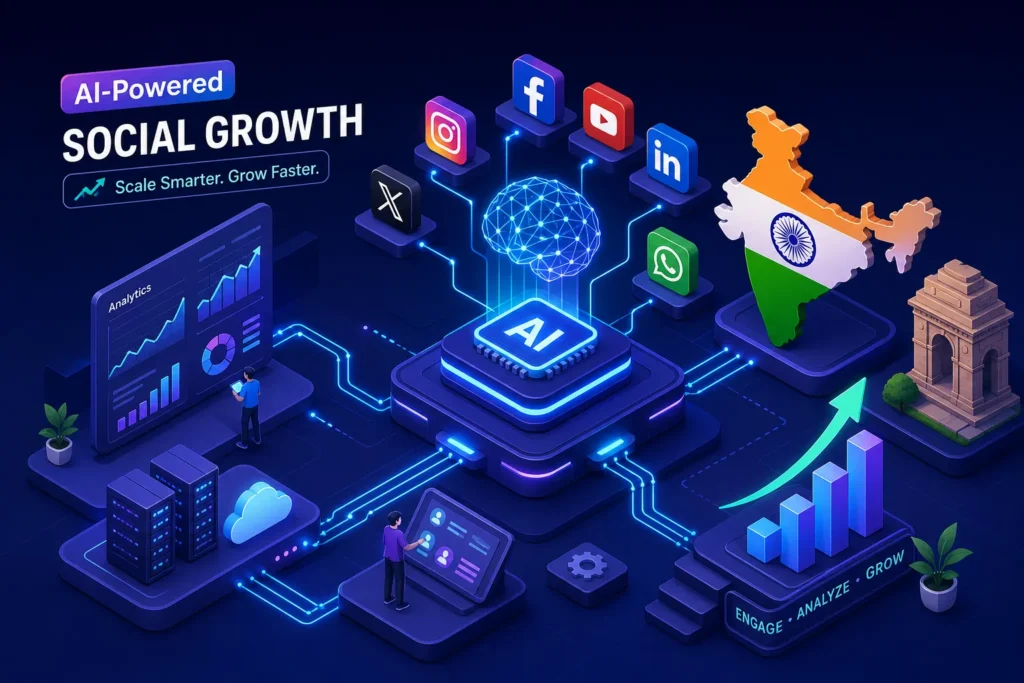
India’s social media user base has grown at a remarkable pace over the past several years and is still climbing. And yet, walk into most brand marketing meetings in Mumbai, Bengaluru, or Delhi, and you will find teams reviewing last month’s post calendar as if the calendar were the strategy. Three posts a week, a boosted reel on festival days, and a quarterly “engagement report” full of follower counts that no one can quite connect to revenue.
The brands pulling ahead are not the ones with the largest budgets. They are the ones who recognised a more uncomfortable truth: social media marketing India has become an intelligence problem, not a content volume problem. Posting more is not the answer. Posting smarter, with AI making decisions in real time, is what separates compounding results from a flatline audience.
This guide maps out how AI-powered social media agencies are rewriting platform strategy, audience targeting, and content production across India. If you are evaluating partners, shortlisting agencies, or trying to understand what a capable agency should actually deliver, this is the framework you need.
Why AI is rewriting the rules of social media marketing in India
The gap between posting content and running intelligent campaigns
Most brands conflate activity with strategy. Scheduling three posts a week is social media presence; it is not social media marketing. The distinction matters because presence is passive and strategy is active. One fills a feed, the other builds an audience asset that compounds over time.
Think of content volume without data intelligence as noise. Every post, ad, comment, and scroll interaction is a signal. An AI-first agency reads those signals continuously and adjusts the next move accordingly. A traditional agency reads them once a month in a PDF and adjusts the next quarter’s calendar. India’s social media landscape, fragmented across platforms, languages, income tiers, and behavioural segments, makes manual campaign management particularly inefficient. The variables are too many for a human team to process in real time.
What changes when an agency runs AI at the core
The operational shift is significant. Feed algorithm analysis runs in real time. A/B testing of creatives happens automatically across a large number of variants. Budget reallocates to the highest-performing ad sets without waiting for a weekly review. Behavioural audience models update based on live campaign data rather than assumptions made at briefing stage. All of this runs simultaneously.
This is not a feature upgrade on top of a traditional agency model. It is a fundamentally different operating structure for social media services in India. The agency’s value is no longer in the execution of a plan; it is in the quality of the intelligence informing each decision within that plan.
How social media marketing India is being transformed by platform strategy
Instagram and short-form video: where discovery happens first
For D2C and FMCG brands in India, Instagram Reels and YouTube Shorts are major channels for top-of-funnel discovery. The mechanics are well established: the algorithm is widely reported to favour early engagement, watch time, and saves over follower count. AI tools assist with posting time, hashtag clusters, creative formats, and retargeting sequences tailored to each platform’s signal logic. Brands that rely on human intuition for this are essentially guessing where AI-assisted agencies are calculating.
Facebook and LinkedIn: reaching high-intent and B2B audiences
Facebook’s mass-market, vernacular audience and LinkedIn’s professional segment require different content architecture entirely. Facebook remains a dominant social advertising platform in India for regional campaigns, value-driven offers, and vernacular content. LinkedIn, by contrast, rewards thought leadership, hiring narratives, and industry insight for B2B brands. AI-assisted lookalike audience modelling and intent-based targeting make social media advertising far more precise on both platforms, matching the right message to the right segment without manual segmentation guesswork.
Regional language platforms and the tier-2 and tier-3 opportunity
Here is the insight that most brand marketing teams still underweight: a large portion of India’s next wave of social media users are not English speakers. They are on platforms consuming content in Hindi, Tamil, Telugu, Kannada, Bengali, and Marathi. AI translation and localisation tools, combined with platform-specific audience data, allow agencies to build Bharat-first campaigns that feel native rather than translated. Brands that move into this space now are building audience assets that will be extremely difficult to dislodge later.
Audience targeting that goes beyond demographics
From manual segments to behavioural intelligence
Demographic targeting, age, city, gender, income bracket, is table stakes. It was the best available option a decade ago. Behavioural targeting is a different category altogether. It reads purchase intent signals, scroll behaviour, content interaction patterns, and cross-platform activity to build a picture of where a person is in their decision journey, not just who they are.
AI models ingest first-party and platform data to build dynamic audience clusters that update in real time. These are not static lists assembled at campaign launch and left to decay. They are living models that respond as campaign data accumulates. A social media management agency in India that still relies on static demographic segments is working with outdated infrastructure, and the results will reflect that.
Real-time optimisation versus the set-and-forget approach
Continuous campaign learning is the operational difference between an AI-first agency and a conventional one. The system adjusts creative rotation, bidding strategy, and audience suppression daily. When a creative variant underperforms, it gets rotated out. When a new audience cluster shows high purchase intent, budget shifts toward it. Many AI-enabled systems can execute these adjustments without requiring a human to review a report and approve a change first.
Many agencies report improved click-through rates and lower cost per lead when running continuous AI optimisation compared with static campaign management, a pattern seen across D2C and BFSI verticals in India. The compounding effect is real: each day’s data makes the next day’s targeting more accurate. Over three months, the gap between an AI-optimised campaign and a manually managed one becomes very difficult to bridge.
Content automation with a creative human at the wheel
How generative AI accelerates content production for social campaigns
Content automation in practice means AI-assisted copywriting for captions and ad scripts, generative image and video brief creation, and automated content calendars built from live trend data. In India, where brands often need high volumes of localised, multilingual, and platform-specific content, the speed advantage alone is significant. Generative AI tools can substantially reduce production turnaround time, work that once took two weeks may now take a fraction of that, depending on the campaign scope and agency workflow. For a clear perspective on how generative models are reshaping creative pipelines, see an analysis of how generative AI is reshaping content creation here.
Pure automation carries a real cost, though. Generic output, brand voice drift, and content that reads as algorithmically assembled rather than authentically crafted will erode audience trust faster than no content at all. The volume advantage of AI is worthless if the output does not resonate.
How OnlinEmage blends AI output with human creative direction
OnlinEmage has built its social media practice around exactly this tension. The agency uses AI for speed, data, and iteration: generating multiple content variants, testing them against audience signals, and surfacing what the data indicates will perform. Human creative strategists then select, refine, and approve what goes live, keeping brand narrative, tone, and cultural context firmly under human control. You can read more about OnlinEmage’s approach to AI Content Creation & Strategy Services | OnlinEmage.
The model works because it does not replace creative judgment; it accelerates the path to good judgment. AI generates the options, humans make the call. The result is content that is both data-informed and genuinely engaging, which is the standard every brand should hold their digital marketing agency to when evaluating social media partners in India.
Services, pricing, and KPIs: what a top agency delivers
What a standard social media services package includes
A top-tier Indian SMM agency typically covers content creation, community management, paid social advertising across Meta, YouTube, and LinkedIn, performance reporting, and strategy reviews. These are the core deliverables. Influencer marketing and UGC production are common add-ons rather than default line items, and it is worth confirming at proposal stage whether they are included or separately quoted. The best social media agencies in 2026 are also building in AI tooling transparency as a standard part of the client conversation. For a view of typical scope and offerings, review the agency’s Digital Marketing Services | OnlinEmage.
Pricing bands for SME and enterprise brands in India
Monthly retainer ranges vary significantly by scope and agency capability. The following is an illustrative market reference for 2026; actual retainers vary widely depending on city, agency experience, and campaign complexity:
- SME brands: ₹25,000, ₹1,50,000 per month for standard social media management and paid social across two to three platforms
- Enterprise and mid-market: ₹2,00,000, ₹10,00,000+ per month for multi-platform strategy, AI-assisted targeting, dedicated account teams, and deeper analytics
- One-time campaign fees (SME): typically ₹50,000, ₹3,00,000 for a campaign launch or promotional burst
These figures assume a full-service agency, not a freelancer or a basic content posting service. Scope expansions for video production, influencer coordination, or aggressive lead-generation goals will push costs upward. For additional market references on typical agency retainers, see this guide to marketing agency monthly retainer cost.
KPIs that actually matter beyond follower count
Follower count is a vanity metric. The KPIs worth tracking are the ones connected to business outcomes. Engagement rate is a genuine signal of content resonance; the industry benchmark for active brand accounts on Instagram sits at 3 to 5 per cent. Cost per lead and cost per acquisition for paid social campaigns are the commercial anchors. Branded search lift and referral traffic from social channels capture downstream intent signals that many agencies overlook. For e-commerce and D2C brands, ROAS on social commerce campaigns is the ultimate commercial accountability metric. You can compare platform benchmarks and engagement data with third-party social media benchmarks here.
How to shortlist the right social media marketing agency India: a buyer’s guide
A five-point checklist to evaluate any social media agency
Evaluating an agency proposal requires a structured lens, not just a gut read on the pitch deck. These five criteria cut through the noise:
- Case studies with named outcomes: verify engagement uplift, ROAS, or CPL improvements from real clients, not hypothetical projections
- Platform specialisation: confirm native experience on the platforms your brand actually uses, not just a generic “we cover all platforms” claim
- AI tooling transparency: ask which specific tools they use for audience targeting, content generation, and reporting
- Human oversight structure: understand who reviews and approves content, because AI output without editorial control is a brand risk
- Reporting cadence: monthly reports are the minimum standard; weekly dashboards are what active campaigns require
When validating case studies, third-party examples of measurable ROI can be useful to benchmark claims; see a collection of case studies on ROI with a digital marketing agency here.
Questions to ask before signing with any SMM agency India
Three questions cut to the heart of an agency’s actual capability. First, what does your AI optimisation process look like mid-campaign, specifically around creative rotation and budget reallocation? Second, how do you maintain brand voice consistency when using AI-generated content? Third, can you show a case study from our industry with verifiable outcome data?
Agencies that answer the first question with a vague reference to “monitoring performance” are likely not running real-time AI optimisation. Agencies that answer the second question with a clear editorial structure, where AI generates and humans approve, are operating at the right standard. Agencies like About OnlinEmage | AI-First Digital Marketing Agency, built AI-first from the ground up, are worth evaluating early in the shortlisting process, particularly when platform strategy, content automation, and measurable ROI are the primary decision criteria.
The strategic infrastructure decision most brands get wrong
The question for Indian brands is no longer whether to invest in social media marketing. Every brand is investing. The real question is which operating model will compound results over time and which will produce a flat line with a growing invoice.
Social media marketing India is, at its core, an intelligence problem. The agencies solving it are the ones running AI at the core, not applying it selectively as an add-on feature to a traditional workflow. Every platform signal, every content interaction, every rupee of ad spend is a data point. The agency’s job is to learn from all of it, simultaneously, faster than any human team can.
Choosing a social media agency is not a vendor decision. It is a strategic infrastructure decision. The right partner builds an audience asset and a compounding data advantage. The wrong one builds a campaign history. If your brand is ready to move from reactive social posting to an AI-powered, results-driven programme, OnlinEmage is a natural starting point for that conversation.
