
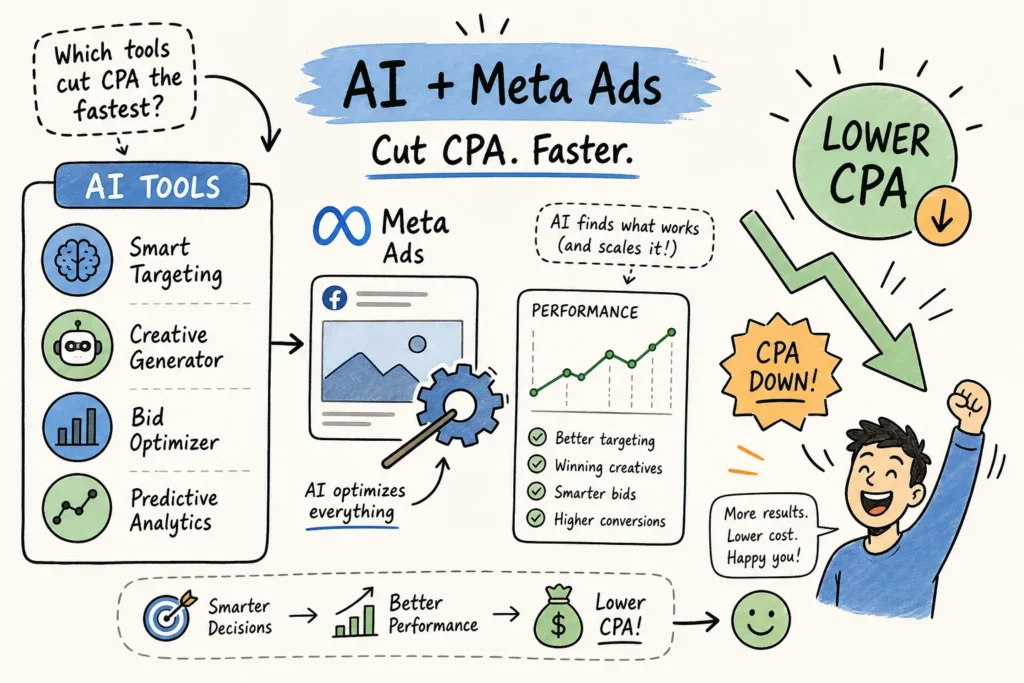
Here is a quiet truth that most Meta advertisers haven’t fully reckoned with: the AI optimising your campaigns is already making decisions. Right now, while you’re reviewing last week’s numbers and debating whether to swap out a creative, Meta’s system is processing a vast number of real-time micro-decisions across your account. Bid adjustments. Placement rotations. Audience expansions. All of it, continuously, without you.
The real problem isn’t whether to use AI for Meta ads. It’s that most campaigns are structured in ways that actively fight against the algorithm rather than work with it. Overlapping ad sets fragment the learning signal. Manual budgets prevent real-time reallocation. Creative fatigue slips by undetected for weeks. The result is a system doing its best with one hand tied behind its back. This article walks you through a clear shortlist of tools, verified performance benchmarks, and a concrete implementation plan to fix that.
The gap between human optimisation and machine speed
Many advertisers still treat Meta ad management as a weekly task. You check performance on Friday afternoon, adjust a bid, pause a weak creative, and move on. The problem is structural, not motivational. Meta’s auction operates in real time, factoring in live behavioural signals, placement competition, and historical conversion likelihood simultaneously. Human adjustments based on yesterday’s data are always playing catch-up.
Think of it this way: steering a car by looking in the rear-view mirror. That’s essentially what manual bid management asks you to do. By the time you’ve identified a pattern in your campaign data and acted on it, the auction has already moved. AI-driven bidding within Meta operates on current-session signals, not last week’s report, which is precisely why AI for Meta ads has moved from an experiment to a structural requirement for competitive accounts.
Creative fatigue compounds the problem. On high-frequency audiences, fatigue can appear quickly, yet many advertisers don’t catch it until CTR has already dropped and CPAs have drifted upward. The cost of slow creative decisions is invisible until it’s expensive. By contrast, AI ad creative generators can test large numbers of creative combinations simultaneously, making rotation a continuous process rather than a monthly task. That asymmetry is where budget quietly disappears.
How AI for Meta ads reshapes campaign performance
AI isn’t a single lever you pull. It operates across three distinct layers, targeting, creative testing, and budget allocation, each affecting a different metric. Understanding that separation helps you diagnose exactly where your campaigns are losing efficiency.
AI-powered targeting beyond interest segments
Meta Advantage+ Audience uses Pixel data, Conversions API signals, and customer lists as learning inputs rather than hard constraints. Your manually defined audience becomes a starting point, not a ceiling. The algorithm identifies converters across broader behavioural patterns that manual targeting would never surface. But here is the critical detail: CAPI is the fuel this entire system runs on. Without server-side signals, especially post-iOS privacy changes, the AI is learning from incomplete data. Shopify merchants who have implemented CAPI correctly report 15, 40% more attributed conversions, and around two-thirds report improved ROAS after setup. Setting up CAPI is not optional for AI-driven targeting to function accurately.
Creative testing at the speed of machine learning
Advantage+ Creative generates and tests image and video variations automatically, adjusting aspect ratios, brightness levels, and text overlay combinations across placements. The reported uplift is significant: according to Meta’s internal Advantage+ performance data, AI-generated creative delivers meaningfully higher CTR compared to human-designed static assets, with some studies citing figures around 18%. There is an important distinction to understand here. Passive creative enhancement means Meta adjusting your existing assets. Active creative generation means the system producing new variants. Meta provides toggle controls for specific enhancements, restricted word lists for generated text, and preview samples before launch. Configure these guardrails before your campaign goes live, not after you notice something off-brand.
Budget allocation that follows live performance
Campaign Budget Optimisation within Advantage+ reallocates spend across ad sets continuously based on real-time performance signals. A human checks data at fixed intervals and reallocates retrospectively. The AI shifts spend toward the highest-converting audience segments before the opportunity closes. This is the most direct mechanism for CPA reduction: when budget follows conversions automatically, your cost-per-acquisition drops without additional manual effort. Meta’s published Advantage+ benchmarks indicate Sales campaigns can deliver substantially higher ROAS and lower CPA compared to manual setups, figures of around 32% ROAS improvement and 17% CPA reduction have been cited in Meta’s own performance studies, though results vary by vertical and account maturity. Separately, the PushGroup case study reported a 38% ROAS increase, 23% CPA reduction, and an 83% increase in managed spend within three months.
Meta Advantage+ versus third-party AI platforms
Advantage+ is the dominant native solution, but it isn’t the only option. A growing ecosystem of third-party AI ad management platforms connects to Meta Ads Manager and executes bidding, budget, and creative decisions autonomously. Understanding where Advantage+ stops and where third-party tools add value is essential before committing budget to any platform.
Advantage+ consolidates campaign architecture into a single campaign, replaces funnel-layer splits, and manages targeting, placement, and creative automatically. The learning phase requires approximately 50 conversions per week for standard campaigns, though Advantage+ Shopping campaigns now exit learning at around 25 weekly purchases. The limitation most advertisers underreport is the loss of granular control. Broad targeting and opaque attribution make it difficult to isolate why performance changes. Brand consistency is a real concern too: the AI can modify assets in ways that conflict with brand guidelines if guardrails aren’t configured proactively. For a helpful primer on how the suite functions and the choices it exposes, review the Meta Advantage Suite overview.
Several third-party platforms deserve consideration for Meta ad automation in 2026, and three stand out for different reasons. Madgicx offers an Autonomous Ad Buyer that manages budget allocation, audience testing, and creative rotation with minimal input, priced from approximately $49/month to $299/month based on ad spend tiers (verify current pricing with the vendor). Ryze AI executes bid, budget, and creative changes around the clock and positions itself as a fully autonomous solution, pricing of approximately $497/month has been reported, though this should be confirmed directly with Ryze as figures vary across sources. Adwisely is the most accessible entry point for e-commerce brands, tapping directly into Advantage+ machine learning via a Shopify-native interface without complex field mapping. For Indian e-commerce brands managing INR-based budgets, Adwisely offers a clean Shopify integration path worth evaluating; confirm current GA4 and WooCommerce compatibility with each vendor before committing, as integration support evolves. The important nuance here: third-party tools generally augment Advantage+ rather than replace it, making them complementary investments rather than competing alternatives.
Why even good AI tools underperform without trained models
Using an AI ad management platform straight out of the box is not the same as using one trained continuously on your specific campaign data. Most AI platforms are trained on population-level patterns: which creative formats tend to drive conversions in a given category, which audience signals correlate with purchase intent across millions of accounts. What they don’t know is your specific acquisition funnel, your product’s price sensitivity, or how your audience behaves differently in October compared to March. A tool calibrated to the average will optimise toward the average, not toward your ceiling.
This is where OnlinEmage‘s approach differs from a standard tool subscription. As an AI-first digital marketing agency running Meta campaigns across multiple verticals, OnlinEmage continuously trains its models on campaign-specific data: historical creative performance, audience response patterns, bid behaviour, and seasonal conversion shifts. The algorithm isn’t configured once at onboarding and left to run, it’s treated as a system that improves with every campaign cycle, compounding performance improvements rather than generating one-time lifts. For businesses that want to outperform manual Meta ad management without building that capability in-house, this kind of managed AI-first approach handles the infrastructure, the learning loops, and the optimisation simultaneously.
Matching tools to your ad spend and campaign goals
The goal isn’t to use every AI tool available. It’s to identify the two or three that fit your current ad spend level, technical stack, and campaign objectives, then test them systematically. These spend-tier recommendations reflect typical practice and vendor positioning rather than universal thresholds, your mileage will vary by vertical and campaign maturity.
At under $5,000/month in ad spend, Meta Advantage+ with CAPI properly configured is sufficient to start. Between $5,000 and $30,000/month, adding Madgicx at the Growth tier (approximately $149/month) layers creative analytics and autonomous budget management on top of Advantage+. Above $30,000/month, fully autonomous platforms like Ryze AI start to justify their cost through the precision of around-the-clock execution. For Shopify-based Indian brands managing multi-currency attribution, Adwisely offers clean integration without complex field mapping, making AI for Facebook ads and AI for Instagram ads manageable from a single interface.
Before trialling any platform, ask whether it executes changes autonomously or only recommends them, whether it has verified integration with your Shopify or WooCommerce store and analytics stack, and what the minimum data volume is for reliable function. These questions eliminate most platforms quickly and narrow the shortlist to genuine candidates.
A three-phase plan for AI for Meta ads implementation
Phase 1: fix your data foundation before activating the algorithm
Before changing any campaign settings, verify that Meta Pixel is firing correctly on all key events: view content, add to cart, initiate checkout, and purchase. Then set up Conversions API to send server-side signals. This is non-negotiable. Advantage+ and every third-party AI platform on the shortlist learns from conversion data. Incomplete signal coverage produces models that optimise for the wrong outcomes. For Shopify stores, Adwisely and Redbird AI Shopify integration are reported to include CAPI setup as part of onboarding, confirm current onboarding scope with each vendor before relying on this as a technical shortcut.
Phase 2: launch your first Advantage+ test with clear guardrails
Start with a single Advantage+ Sales campaign running alongside your existing manual campaign, targeting the same product at the same budget. Configure brand guardrails upfront: toggle off creative enhancements that conflict with your visual identity, set restricted word lists for generated text variations, and preview AI-generated creative samples before the campaign goes live. Rather than waiting a fixed number of weeks, monitor until your campaign reaches the required conversion threshold, approximately 50 conversions per week for standard campaigns, or 25 weekly purchases for Advantage+ Shopping, before drawing conclusions. Benchmark against your existing campaign’s CPA and ROAS throughout.
Phase 3: layer in a third-party tool and measure the delta
Once Advantage+ is running cleanly and producing reliable data, introduce a third-party platform such as Madgicx or Adwisely based on your spend tier. Track the marginal improvement in CPA, ROAS, and CTR over the following four weeks. If the delta justifies the tool’s monthly cost, scale. If it doesn’t, return to Advantage+ alone and revisit the creative testing cadence manually. The goal is to find your minimum effective AI stack, not to maximise the number of platforms running simultaneously.
What to do next with AI for Meta ads
The central paradox of AI for Meta advertising is this: the AI is already running in your campaigns. The question is whether it has the data, structure, and continuous refinement to actually outperform what a skilled human could do manually. Start with the data foundation. Trial Advantage+ with proper guardrails. Layer in a third-party tool only once the fundamentals are sound.
For businesses that want the compounding improvement that comes from models trained continuously on their specific campaign data, a managed AI-first approach is a more efficient path to lower CPA than a self-serve tool subscription. The gap between where your Meta campaigns perform today and where they could be with properly implemented AI for Meta ads is, at its core, a configuration and data quality problem, and it’s one with a well-defined solution. We combine this approach with specialist services such as AI-Driven Conversion Rate Optimisation | More Leads and AI-Optimised Pay Per Click Marketing | Smarter PPC Ads to capture both traffic and conversion improvements in parallel.
