
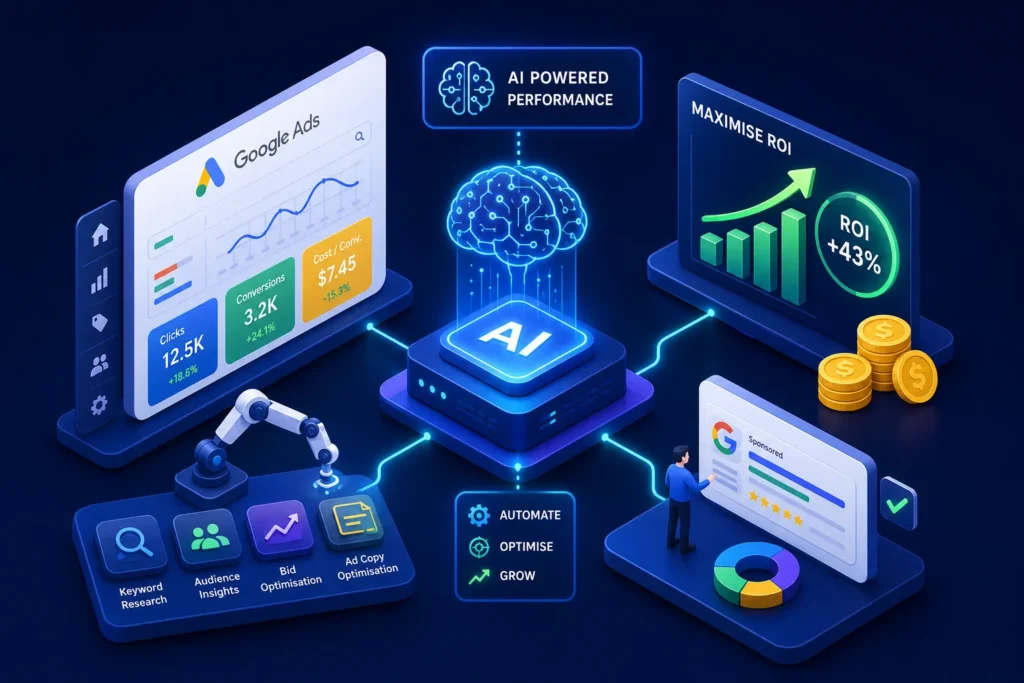
AI for Google Ads is closing the gap between rising auction costs and static management methods, and for most advertisers, that gap has never been wider. Between 2023 and 2025, the average cost-per-click on Google Ads rose by 34%. And yet, many advertisers are still managing bids, budgets, and creatives the way they did a decade ago: weekly reviews, manual adjustments, gut-feel decisions on keyword groupings. Every day your account runs without intelligent optimisation, a measurable share of your budget leaks through underperforming keywords, stale ad copy, and bid adjustments that arrive days too late, a waste that Google’s own platform data and independent audits consistently peg at 15 to 25% of total spend in manually managed accounts.
AI does not replace a well-constructed Google Ads strategy. It executes that strategy faster, at greater precision, and without sleeping. At OnlinEmage, our campaign management workflow is built around this principle: automation handles the data layer, while human strategists handle direction, intent, and creative judgement. The result is a closed loop that compounds over time, rather than a manual process that degrades the moment attention shifts elsewhere.
What follows is a practical breakdown of how AI actually improves campaign performance, which tools are worth shortlisting in 2026, and a checklist to start testing it inside your own account without disrupting what is already working.
Why AI for Google Ads changes what campaigns can actually deliver
Google’s Smart Bidding evaluates an enormous range of signals on every single auction: device type, geographic location, time of day, the exact search query, prior site interactions, and behavioural patterns that indicate purchase intent. A human campaign manager reviewing weekly reports operates on a fundamentally different cadence. By the time a manual review identifies an underperforming bid, many auctions have already been lost or won at the wrong price. Third-party AI platforms like Ryze AI make bid adjustments in under four hours, compared to the days or weeks a typical manual review cycle requires. This speed advantage does not just improve individual auctions; it compounds across an entire campaign lifetime.
The deeper shift is in how AI handles intent. Keywords describe what people type. Intent signals describe why they are searching. Using AI for Google Ads means moving beyond exact-match keyword logic by ingesting behavioural patterns to infer intent from behaviour and signals earlier in the session, well before a user has settled on the precise query they will type. Google’s AI Max for Search campaigns demonstrate this clearly: the MyConnect case study reported a 13% lower cost-per-action and 30% more conversions, largely because the AI unlocked net-new search queries that an exact-match setup would never have captured. The implication is significant. Traditional keyword management defines the ceiling of your reach; intent-based AI modelling can materially expand reach beyond what exact or phrase-match setups allow.
Budget allocation follows the same logic. When a fixed weekly budget sits in a campaign that stops performing on Tuesday afternoon, it continues spending at the same rate until someone notices. AI tools that reallocate budgets dynamically move spend toward the highest-ROAS opportunities in real time. At a time when CPCs are rising sharply, that 15 to 25% waste figure is not a rounding error, it is the difference between a campaign that grows and one that plateaus.
Google’s built-in AI tools and where they fall short
Performance Max is Google’s most comprehensive native AI campaign type. It runs across every Google inventory channel simultaneously, including Search, Shopping, YouTube, Display, Gmail, and Maps. You upload a set of assets, headlines, descriptions, images, and video, and Google’s AI mixes and matches those assets for each placement based on audience signals and search themes, without requiring you to select individual keywords. AI Max for Search (Google’s intelligent query-matching layer introduced in 2025) expands reach beyond what exact or phrase match would allow. L’Oréal reported a 2x higher conversion rate and a 31% lower cost per conversion after adopting AI Max, which represents the upper range of what well-prepared accounts can achieve.
The transparency gap is the honest limitation. Historically, Performance Max lacked placement-level transparency; as of 2026, Google has introduced channel-level reporting and full search-term visibility, which meaningfully addresses the earlier criticism. The 2026 version also offers self-serve campaign-level negative keywords, up to 10,000 per campaign. But for advertisers with CRM data integration requirements, complex audience exclusion rules, or multi-platform budgets spanning Meta and Google simultaneously, native Google AI still hits a practical ceiling. This is where third-party platforms move from optional to operationally necessary.
AI for Google Ads: the best tools worth shortlisting in 2026
Ryze AI is a highly accessible entry point for small and mid-sized businesses, particularly when compared with self-service platforms that require significant in-house expertise to interpret. It operates as a fully managed service, meaning you receive a dedicated human strategist alongside the AI layer rather than a dashboard to interpret alone. For accounts spending between $5,000 and $20,000 per month, the cost sits at $299 per month. Vendor-reported data across more than 2,000 accounts shows an average ROAS improvement of 284% within six weeks, though this figure comes from their own case studies and should be treated as a benchmark to test rather than a guarantee. Integration runs via the Google Ads API, with MCP support that allows natural-language campaign queries through ChatGPT, genuinely useful for account managers who want answers without building custom reports.
Optmyzr suits accounts that have grown past the stage where Smart Bidding alone is sufficient but where the advertiser still wants control rather than full automation. Pricing is transparent and spend-based: $249 per month for accounts up to $10,000 in managed spend, $499 per month up to $25,000, and $799 per month up to $50,000. Its real value is in structured, rule-based account hygiene. The platform continuously scans for optimisation opportunities and queues suggested changes for human approval rather than executing them autonomously. This suits experienced media buyers who want AI assistance with automated bidding on Google Ads without surrendering strategic control to an algorithm they cannot interrogate.
Adalysis and AdCreative.ai cover two separate layers that Smart Bidding does not address. Adalysis, starting at $99 per month, is built specifically for A/B testing of Responsive Search Ads and automated performance audits. It identifies underperforming ad combinations systematically rather than waiting for you to notice. AdCreative.ai functions as an ad copy generator for Google Ads, producing copy variants, images, and video scripts with direct export capability to Performance Max and Display campaigns. Together, these two tools solve the creative bottleneck that causes most accounts to recycle the same three headlines across dozens of ad groups for months at a time.
How OnlinEmage applies AI across every layer of a Google Ads campaign
Most advertisers adopt AI at a single layer of their Google Ads account, typically bidding, while continuing to manage keyword selection, campaign structure, and landing pages manually. OnlinEmage’s approach is to apply Google Ads automation at every decision point simultaneously. Keyword selection draws on predictive search trend data to identify high-intent terms before competition inflates CPCs. Campaign structure decisions are informed by machine learning models that map historical conversion patterns to audience segments. When Smart Bidding receives better inputs at the structural layer, its algorithmic output improves proportionally. This upstream application is what separates accounts that see marginal AI gains from those that see compounding ones.
Landing page performance is part of the same loop. Most agencies optimise ad copy and treat the post-click experience as a separate problem. OnlinEmage integrates AI-driven conversion rate optimisation directly into its Google Ads management, a closed feedback mechanism where ad performance data informs landing page changes, which improve Quality Scores, which lower CPCs, which extend budget reach without increasing spend. Creative assets are iterated continuously using performance signals, with human creative direction maintaining brand consistency across every variant.
Reporting goes beyond last week’s dashboard. Predictive analytics flag budget pacing issues, audience fatigue signals, and ROAS trajectory shifts before they become expensive problems. The operational model separates accounts that get marginal improvements from those that get structural ones: AI as the execution layer across bidding, creative, and measurement, with human strategists making the directional calls that no algorithm is equipped to make alone.
Picking the right tool and staying compliant in India
The decision framework is straightforward. If you need fast bid optimisation with minimal setup, Ryze AI’s managed service is the lowest-friction entry point with human oversight included. If your account runs Search, Shopping, and Performance Max at over $10,000 per month and you want rule-based control rather than full automation, Optmyzr fits that profile. If creative output is the bottleneck slowing your account, AdCreative.ai solves a specific problem without requiring a full platform commitment. Trial one tool against a clear baseline measurement period before layering a second. Running multiple AI platforms simultaneously in the same account creates conflicting optimisation signals and muddies attribution.
The India-specific consideration that most guides overlook is data compliance. The Digital Personal Data Protection (DPDP) Act 2023 requires that personal data is processed only for clear, specified purposes with user consent. When you connect a third-party AI tool to your Google Ads account via OAuth, you are granting access to campaign data, audience information, and conversion records. Before granting API access, verify that the vendor does not use your campaign data for AI model training beyond service delivery, does not sell data externally, and holds Google Ads Certified External Vendor status (verifiable on Google’s official vendor list). Check the tool’s privacy policy for explicit data residency commitments, this is a DPDP compliance requirement, not an optional best practice. The standard Google Ads OAuth scope grants read and write access across your entire account; confirm the tool is requesting only what it actually needs to function.
Confirm the tool only requests the data scopes it needs (specifically campaign management and reporting) and revoke anything broader.
A quick checklist to test AI-driven changes in your account
- Establish a clean baseline. Pull 30 days of campaign data: CPA, ROAS, conversion rate, impression share, and wasted spend from search terms without conversions.
- Pick one tool and one campaign. Do not run multiple AI platforms simultaneously in the same account. Choose a mid-performing campaign, not your top spender, to test.
- Connect via API and audit access scopes. Confirm the tool only requests the data scopes it needs (specifically campaign management and reporting) and revoke anything broader.
- Set a testing window of four to six weeks. Smart Bidding requires approximately 50 conversion events or three conversion cycles to calibrate. Do not judge results before the learning period completes.
- Compare against a control. If your account allows it, run a matched campaign without AI changes alongside your test campaign to isolate the AI’s actual contribution.
- Measure against your own baseline, not industry benchmarks. Your account’s historical performance is the only relevant comparison for the first test cycle.
This checklist is a starting point, not a guarantee. What matters is that each change is testable, measurable, and reversible. An AI tool that cannot be evaluated against a clear before-and-after is not optimisation, that is assumption dressed as progress.
The question is not whether to use AI, but where to begin
AI for Google Ads is not a shortcut. It is an execution layer that compounds the value of every strategic decision you have already made. It amplifies a good strategy, accelerates execution, and eliminates the cognitive lag that makes manual campaign management increasingly expensive as auction complexity grows. The tools available in 2026 span every price point, from free tiers at Adzooma for accounts just starting with Google Ads automation, to enterprise platforms like Skai for multi-market programmes, making meaningful AI ad optimisation more accessible than it has ever been.
The real question is not whether AI belongs in your account. It is where to start and how to measure what it actually delivers for your goals, your audience, and your actual budget constraints. If managing tool selection, API integration, DPDP compliance, and campaign strategy simultaneously feels like too many responsibilities to balance without something slipping, that is precisely the problem an AI-first agency like OnlinEmage is built to solve. Build the strategy first, choose the right tools second, and let the machines handle the rest.
