
The costliest website mistake most Indian businesses make isn’t overspending on website development in India. It’s spending just enough to go live, and then treating the project as finished. A website that merely exists is a liability dressed up as an asset. In 2026, the gap between a site that sits quietly on a server and one that actively converts visitors is wider than ever, and closing that gap begins long before you compare a single quote.
Before you shortlist agencies, argue over budgets, or debate platforms, you need a clear picture of what a high-performing website actually requires. This article gives you that picture: real cost benchmarks by project type, realistic timelines, a plain-language guide to technology choices, and a hiring framework that protects you from the most common and expensive mistakes Indian businesses make when commissioning a new site.
What a high-converting website actually needs in 2026
Too many websites are designed to impress rather than to convert. The visual brief goes in, a good-looking site comes out, and nobody asks whether the information architecture actually guides a visitor toward a decision. That oversight is where most Indian businesses quietly lose money every month.
The UX and speed baseline that most briefs don’t mention
Google’s Core Web Vitals benchmarks in 2026 are non-negotiable for any site that wants to rank and retain visitors: Largest Contentful Paint under 2.5 seconds, Interaction to Next Paint under 200 milliseconds, and Cumulative Layout Shift under 0.1. On India’s mobile-dominant internet, these aren’t technical footnotes; they directly determine whether your site shows up in search and whether visitors stay long enough to read anything. Per Google’s own Core Web Vitals guidance, a page loading its main content within 2.5 seconds on mobile meets the minimum threshold for a good user experience, treat that as the floor, not a premium finish.
Beyond speed, the structural UX requirements are clear: logical information architecture, intuitive navigation that answers “what is this, is it for me, and what do I do next” within seconds of arrival, and consistent design patterns that build trust without demanding effort. These are decisions made in the design phase, not fixes you retrofit later.
AI personalisation and CRO-ready design: the newer layer
High-converting sites in 2026 use AI personalisation to serve dynamic content based on a visitor’s behaviour, location, or referral source. Tools like Dynamic Yield, Optimizely, and VWO allow you to show a different hero message to a visitor arriving from a Google ad versus one coming from a LinkedIn post, each platform segments audiences by traffic source, UTM parameters, and behavioural signals. More importantly, these aren’t add-ons you bolt on after launch: conversion rate optimisation works best when layout decisions, CTA placement, and content hierarchy are designed as testable, data-driven choices from the beginning. For a deeper look at how AI drives modern marketing and personalisation strategies, see our piece on AI in Digital Marketing: Top Tools & Strategies to Succeed.
This is why website development, done well, is a marketing exercise. The technical build is the vehicle; the conversion architecture is the engine. Agencies that understand this distinction produce sites that compound in value over time. Agencies that don’t produce sites that look the part but underperform quietly.
At OnlinEmage, website development is treated as one component of an integrated AI-driven marketing system, built with tracking, SEO structure, ad landing pages, and analytics already designed in from the outset. That integrated approach means the site is ready to perform from day one, not retrofitted for marketing six months after launch.
Realistic website development costs in India for 2026
Most Indian businesses get surprised by development quotes not because agencies overcharge, but because the business owner didn’t know which category of website they actually needed. The categories are genuinely different products with different cost drivers.
Cost by project type: brochure sites, e-commerce stores and custom web apps
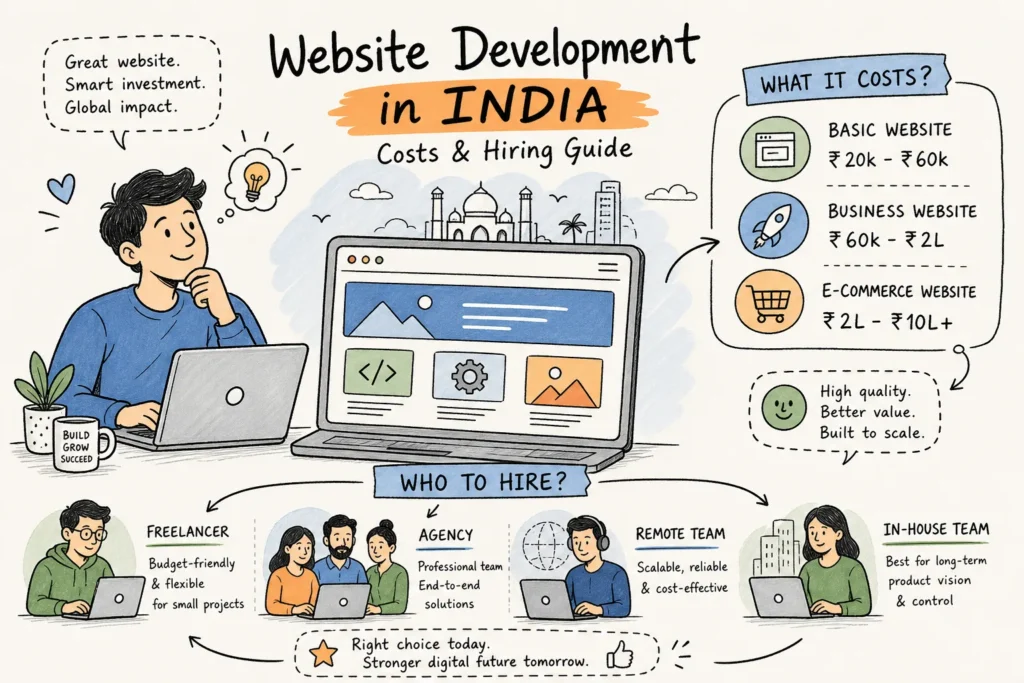
A brochure or basic business site, typically five to fifteen pages, a contact form, and standard CMS functionality, costs between ₹15,000 and ₹50,000 in 2026. These are straightforward projects where templates accelerate the build and customisation is limited. E-commerce web development in India is a different category entirely: expect ₹1,00,000 to ₹5,00,000, with costs climbing quickly once you add a large product catalogue, multiple payment gateways, custom filters, or integrations with inventory and logistics platforms. A 20-product Shopify store and a 500-SKU multi-vendor marketplace are both “e-commerce sites” on a brief, but they are entirely different projects in practice.
Custom web applications, dashboards, portals, platforms with bespoke business logic, typically run ₹2,10,000 to ₹5,40,000 and above. The wide range reflects scope variance: a client portal with a few user roles is structurally simpler than an API-driven SaaS dashboard with complex workflows and third-party integrations. For more detailed price breakdowns across India, you can review industry benchmarks on website development costs in India.
Freelancer vs agency pricing: what the gap actually reflects
A freelancer will often quote 30, 50% less than an agency for the same scope. Market surveys of Indian web development engagements consistently show this range, though the precise gap depends on project complexity and the freelancer’s experience level. That difference rarely reflects a skill gap. It reflects accountability, process, and what happens after launch. An agency quote typically includes project management, revision cycles, QA testing, deployment, and a defined post-launch support window. A freelancer quote may omit several of those elements, defined project management, post-launch support, and formal QA testing are commonly excluded from freelancer proposals. Neither arrangement is universally the right choice, but you need to know what you’re buying before you use price as the primary filter.
Timelines for website development in India you can actually plan around
Most project delays aren’t the developer’s fault. They are caused by unclear briefs, slow content delivery, and stakeholder feedback loops that nobody planned for. That understanding should shift how you approach the engagement from the start.
Small, medium and large projects: phase-by-phase breakdown
Small projects, brochure sites with a clear brief and fast content approvals, typically complete in two to six weeks. The same project with three rounds of stakeholder review and delayed copy can stretch to eight or ten weeks with no change to the development work at all. Medium projects run six to twelve weeks, covering multi-page corporate sites and standard e-commerce builds. Large or custom projects require three to six months or more, with deep discovery, UX system design, complex development, staging, and phased deployment all adding time that cannot be compressed without risk. For general industry timing guidance, read about typical timelines for building a website in resources such as the how long does it take to build a website overview.
What actually slows projects down and how to avoid it
The real culprits are predictable: undefined scope, content that isn’t ready at kick-off, approval chains with multiple decision-makers, and scope creep during development. You can compress timelines meaningfully by doing four things before the project begins:
- Prepare a full content inventory, every page, every image, every piece of copy, before development starts.
- Agree on a revision policy upfront: how many rounds are included, and what counts as a new request versus a correction.
- Nominate a single internal point of contact with authority to approve decisions.
- Lock the scope before development begins and treat changes as a separate brief.
Choosing the right technology stack for your goals
Technology should follow purpose. The right question is never “which platform is best?” but “which platform is best for this specific goal, budget, and team?” For most Indian businesses, that question has a clear answer once the functional requirements are on paper.
WordPress, Shopify and Magento: when each platform earns its place
WordPress is the right choice for content-heavy marketing sites, service business websites, and blogs where SEO-driven content is central to the strategy. Any experienced WordPress developer in India will confirm it’s the lowest-cost option for standard builds, with a mature ecosystem of themes and plugins that accelerate development. Shopify suits hosted e-commerce stores where speed of setup, lower operational overhead, and ease of management matter more than deep customisation. Magento suits complex, large-scale e-commerce requiring high customisation and enterprise-grade scalability; it carries the highest build cost in this category. One important clarification: a heavily customised WordPress site can cost more than a standard Shopify store, because scope and complexity drive price more reliably than the technology label itself.
React/Node and Laravel for custom builds: what justifies the investment
Custom-stack development makes sense when you’re building something that doesn’t fit a CMS model: complex dashboards, API-driven platforms, custom user portals, or applications with unique business logic that off-the-shelf solutions can’t accommodate. React/Node and Laravel/PHP sit in the mid-to-high cost range but offer the most flexibility for future scaling and technical evolution. For most small-to-medium business websites, the right CMS is a smarter investment than a custom build. Custom stacks are justified by specific functional requirements, not by a general preference for “something unique.”
How to hire for website development in India: find, shortlist and sign with confidence
Most hiring mistakes happen not because businesses chose bad agencies, but because they asked the wrong questions before signing. A framework for hiring well is more valuable than any ranked list of firms. When you’re looking to hire a web developer in India, the process you follow matters as much as the partner you choose.
What strong agency portfolios actually tell you (and what they hide)
Reading a portfolio critically means looking beyond aesthetics. Search for projects similar to yours in scope and industry. Read case studies for the problem solved, not just the visual output. Check whether client reviews on platforms like Clutch or Google mention communication and project management, not just final results, a beautiful site delivered three months late with poor communication is a poor outcome regardless of how it looks. Any reputable web development company in India worth shortlisting will have consistent review volume, clear process documentation, and transparent proposals. Prioritise those over firms with impressive visuals and thin evidence of delivery.
The questions to ask before signing any contract
Six questions separate a clear brief from a costly surprise:
- What does your post-launch support period cover, and for how long?
- How do you handle scope changes and additional requests mid-project?
- Who owns the code and all assets at the end of the project?
- What does “SEO-ready” mean specifically in your deliverables?
- Will this site integrate with our marketing stack, CRM, and analytics tools?
- What is your testing process before deployment?
Why bundling development with AI-driven marketing compounds your ROI
Building a website in isolation and then trying to layer on SEO, paid advertising, and content marketing afterward is structurally less efficient than working with a partner who builds the site as part of an integrated marketing system. When development, SEO architecture, conversion optimisation, and analytics are designed together from the start, the site performs faster and scales further. Website Design and Development Services that combine these disciplines avoid the rework and mismatched priorities that kill ROI.
OnlinEmage combines website development with AI-driven SEO, Meta Ads management, Google Ads management, and conversion rate optimisation, so every technical and marketing decision is aligned from day one, not reconciled after the fact.
Post-launch support, maintenance and the layer most projects miss
Launching a website is the beginning of the project, not the end. The businesses that get the best returns from website development in India are those who budget for what comes next, not just what gets built.
What reputable agencies typically include vs charge separately
Standard post-launch inclusions from reputable Indian agencies cover bug fixes, security patches, CMS updates, basic performance monitoring, backups, and launch stabilisation support. Post-launch maintenance retainers in India typically run ₹15,000 to ₹60,000 per month depending on site complexity and support level. What is charged separately is important to understand: ongoing SEO work, content updates, advanced performance optimisation, PPC and digital marketing services, CRM integrations, and custom enhancements after the initial build all fall outside the standard scope. An agency that promises an “SEO-friendly build” is not promising an ongoing SEO strategy. Knowing that distinction before you sign prevents the budget surprises that tend to surface in the weeks after launch. For contract and maintenance considerations, review common clauses in a website development and maintenance agreement.
The SEO and marketing investment that makes development spend worthwhile
A website without a traffic and conversion strategy is a brochure no one picks up. The investment in development only compounds when it’s followed by consistent SEO, paid traffic, and content work in year one. For most Indian businesses, that means budgeting for at least basic technical SEO, Google Analytics 4 setup, and a content calendar alongside the development retainer. The compounding begins when each of those channels feeds data back into the others: search performance informs content, content informs ad creative, ad performance informs landing page optimisation. That cycle is what separates a site that grows from one that stagnates.
The final framework worth keeping
The quality of your website in 2026 is not determined by how much you spend. It’s determined by how clearly you understand what you’re building and why. Get your project category and budget right first. Choose a platform that fits your operational reality and growth goals, not just your launch brief. Ask the six questions before signing any contract. Treat post-launch marketing as part of the same investment, not a separate decision you’ll make later.
For businesses investing in website development in India, the most important shift is treating the site as an ongoing asset rather than a one-time deliverable, one that earns its value through consistent traffic, targeted campaigns, and continuous optimisation. The agencies worth hiring already know this, and they’ll tell you so in the first conversation, before you’ve paid them a rupee.
