
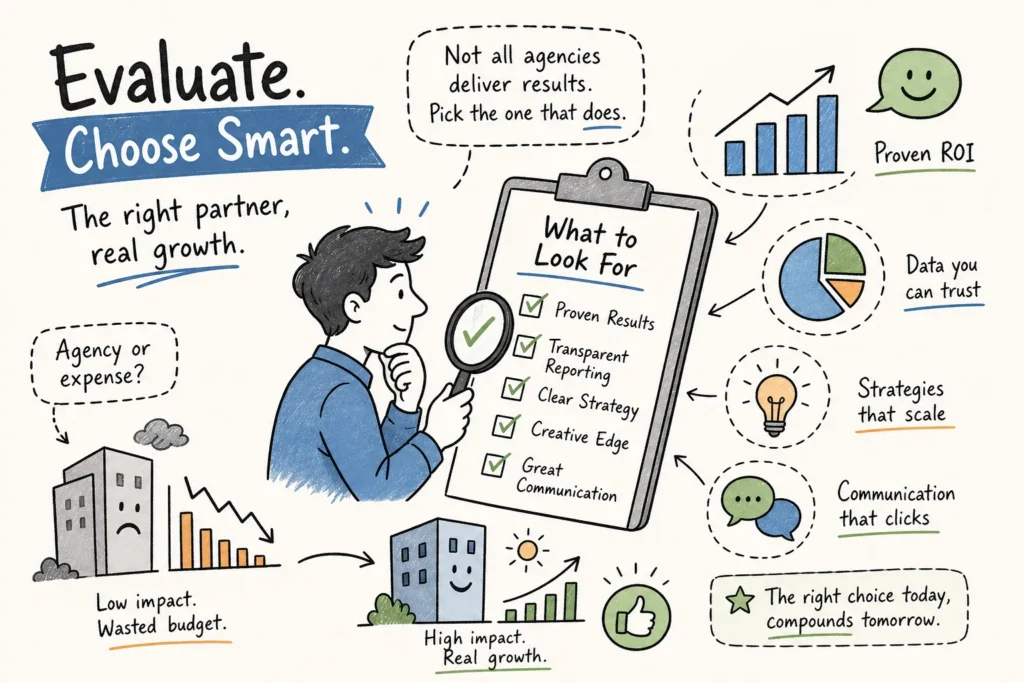
Many clients only recognise that they’ve hired the wrong performance marketing agency during the 90-day review. The reporting looks polished, the account manager is responsive, and the dashboards are full of colourful charts. But the revenue hasn’t moved. Leads are up on paper, but they don’t convert. ROAS looks acceptable until you notice the attribution model may be counting the same conversion across multiple channels.
The problem isn’t a lack of options. India has many agencies positioning themselves as results-driven, ROI-focused, and performance-obsessed. A common pitfall is evaluating them the wrong way: comparing creative portfolios and case study aesthetics instead of asking about attribution models, AI infrastructure, and what happens to the budget when a campaign underperforms at 2 a.m. on a Tuesday. This guide gives you a framework to cut through that noise, ask the right questions, and choose a performance marketing agency you won’t regret signing with three months later.
What “performance marketing” actually means in 2026
Performance marketing, in its truest form, is a financial contract disguised as a marketing engagement. You pay for measurable outcomes: leads, sales, app installs, revenue, not for hours worked or impressions served. But that definition has been considerably diluted. Many agencies now badge standard paid media management as “performance marketing” without any genuine accountability to business outcomes, and the distinction matters more in 2026 than it has in previous years.
The arrival of AI-driven campaign optimisation has reshaped what a serious performance marketing company in India can and should deliver. Manual bid adjustments, weekly A/B tests, and monthly budget reviews are no longer competitive advantages; they are table stakes at best. Agencies still operating this way are not just slow adopters but structurally limited in the outcomes they can achieve. The real question to ask any performance marketing agency in 2026 isn’t what they do. It’s how fast their system responds when a campaign metric moves in the wrong direction.
The metrics that reveal whether a performance marketing agency is truly accountable
India’s performance marketing landscape has matured significantly. Leading agencies working on e-commerce campaigns report ROAS figures ranging from 5x to 15x on well-optimised accounts, with published case studies from firms such as ROI Hunt documenting returns of 7x to 15x on specific campaigns. Based on published agency benchmarks in India, CPA reductions of 60 to 80 per cent after six months of structured optimisation are achievable, and monthly lead volumes growing by 100 to 165 per cent on mature accounts have been documented by agencies including Intrepid Digital and The Marketing Agency. For comparison, average e-commerce ROAS by vertical (2026) sits lower, which means the better Indian performance marketing agencies are outperforming the global baseline by a meaningful margin.
Acquisition efficiency: CPA and ROAS
For lead generation campaigns, a credible ROI-driven digital agency should produce CPL benchmarks by industry, not generic global averages, but India-specific numbers calibrated to your sector and monthly ad spend. In the education sector, for instance, a well-run AI-optimised pay per click marketing agency in India might target CPLs in the ₹300, ₹800 range depending on course value and funnel depth. If an agency can’t produce sector-specific benchmarks in the first conversation, this may indicate they are managing campaigns at the account level rather than thinking about your broader business economics. Follow up by asking which verticals they have the most tracked data on.
Lifetime value and multi-touch attribution
CPA is a useful efficiency metric, but it tells you nothing about the quality of what you’re acquiring. Customer lifetime value and proper multi-touch revenue attribution are where agencies demonstrate whether they think like business partners or media buyers. Ask specifically how the agency tracks revenue beyond the first conversion, whether they integrate with your CRM, how they handle cross-channel attribution, and what happens to LTV data in their optimisation model. Agencies that answer this fluently are operating at a different level than those who pivot back to CTR and click volume.
AI optimisation capabilities every performance marketing agency must have
The practical difference between an AI-first agency and a traditionally operated one shows up most clearly in how budgets respond to performance signals. In a traditional setup, a campaign running at poor ROAS on a Tuesday evening gets reviewed at the next scheduled check-in, perhaps Thursday morning. By then, you’ve already spent budget that a smarter system would have redirected elsewhere. The money is gone, and the insight arrives two days too late to do anything useful with it.
AI-driven performance marketing services run automated rules and predictive models that detect underperformance in real time, then shift spend towards better-performing channels, audiences, or creatives without waiting for a human to log in. The system ingests performance signals, predicts the best next move, and executes bid and budget changes automatically. That is why these agencies emphasise ROAS lift, lower wasted spend, and faster scaling as the main outcome differentiators.
At OnlinEmage, AI-First Advertising & Agentic AI is built into the operational backbone of every campaign, not as a reporting layer on top of manual work, but as the engine making optimisation decisions continuously. The predictive budget allocation model analyses performance signals across Google Ads, Meta, and other channels simultaneously, redistributing spend based on where the data says the next rupee will work hardest. For brands that have grown frustrated with agencies that show great dashboards but deliver mediocre results, this structural distinction is the one worth interrogating most carefully during any agency evaluation.
Reporting transparency and what a trustworthy dashboard looks like
There is a meaningful difference between an agency that sends you a monthly PDF and one that gives you live access to a Looker Studio dashboard connected to your actual ad accounts, GA4 data, and CRM. The former is telling you a story. The latter is giving you visibility. Agencies that resist sharing live dashboard access often have something to hide, not necessarily fraud, but a gap between the metrics they choose to highlight and the ones that would prompt harder questions.
The standard reporting stack for a mid-market client in India’s more sophisticated agency market typically includes live dashboards in Looker Studio, Meta Ads Manager with properly configured Pixel tracking, and Google Ads connected to GA4 with goal-level attribution. Beyond the tools, weekly reports should document what changed, why it changed, and what the next action is, not just what the numbers were. If an agency’s reporting cadence is “monthly only” for an active paid media account, that is a structural misalignment between their operating rhythm and yours. Make sure the contract specifies the KPIs and reporting cadence you’re entitled to review, see a practical list of common marketing agency KPIs organisations track.
Campaign scalability and the first 90 days
The first 90 days with any performance-based marketing agency follow a predictable shape: discovery and access in weeks one to four, strategy and first launches in weeks five to eight, and active optimisation with scaling decisions from week nine onwards. Agencies that set honest expectations about this timeline are usually the ones worth keeping. Those that promise results in 30 days are either running accounts on autopilot or making claims they can’t substantiate with data, a red flag that industry guidance consistently flags as a warning sign.
By day 90, a serious agency should have delivered: a documented audit and findings summary, a signed-off strategy and roadmap for the next quarter, a properly functioning tracking and measurement setup, and at least one live campaign producing actionable data with specific KPIs attached. If these deliverables are vague at this stage, they will remain vague.
On pricing, Indian performance marketing agencies use three primary structures: a fixed monthly retainer (₹30,000 to ₹2,50,000 or more depending on scale and channel mix), a retainer plus a percentage of ad spend (typically 10 to 15 per cent of managed spend), or a hybrid model that combines a base fee with a performance bonus when agreed KPIs are exceeded. The number to scrutinise isn’t the retainer itself. It’s what the retainer includes in terms of optimisation hours, creative iterations, and reporting depth. A low retainer that covers only basic account management is rarely the cost-efficient option it appears to be. For more on agency retainer structures and fee models, review common retainer fee models explained.
Questions to ask before you sign the contract
Before signing with any performance advertising agency, ask these questions directly and evaluate the quality of the answer, not just the content. The thinking behind a response tells you far more than the response itself:
- How do you handle budget reallocation when a campaign underperforms mid-week?
- What attribution model do you use, and how do you handle cross-channel conversions?
- Can you share a live dashboard example from a current client (anonymised)?
- What is the testing cadence for creative and audience iterations?
- How do you measure success beyond ROAS, specifically around LTV and pipeline contribution?
- What does your first 90-day deliverable list look like in writing?
- What happens to the account data if we part ways?
A few agency behaviours should disqualify a partner immediately: vague answers about attribution methodology, resistance to live dashboard access, no written KPI commitments in the contract, case studies that only show click-based metrics without revenue data, and promises of guaranteed results within an unrealistically short window. The best performance marketing agencies in India are honest about ramp-up timelines, transparent about the tools they use, and confident enough in their methods to show you real numbers from real campaigns.
Watch for contracts that include monthly-only reporting, spend-based fee structures where the agency earns more when you spend more, and clauses that give the agency ownership of your ad accounts, pixels, or creative assets. These are structural conflicts of interest, not just administrative preferences. An agency that controls your data also controls your ability to verify what they’re actually doing with your budget. If they hesitate on any of the questions above, that hesitation is the answer.
Choosing the performance marketing agency that earns the callback
Choosing the right performance marketing agency comes down to fit across three dimensions: whether their capabilities match your growth goals, whether their reporting cadence supports your decision-making, and whether their technology operates at the speed the market demands. In 2026, that last dimension has become decisive. AI-first agencies have a structural advantage over traditionally operated ones, not because they use smarter tools in isolation, but because those tools work continuously in ways that human-only teams simply cannot replicate.
Use the framework in this guide to build a shortlist of three to five performance marketing agencies. Then use the seven questions above to stress-test each one. The agency that responds with specificity, data, and transparency is almost certainly the one worth calling back. One that leans on enthusiasm without evidence, no tracked case studies, no live dashboard access, no written KPI commitments, is the one to cross off. Apply that filter consistently, and you’ll avoid three months of polished reports that move nothing. If you’d like a practical checklist on how to select the best digital marketing agency in India, that resource walks through the evaluation steps in more detail.
If you want to see what an AI-first approach to performance marketing services looks like in practice, OnlinEmage is worth a conversation. Bring your current metrics, your budget, and those seven questions. The answers will tell you what you need to know.
