
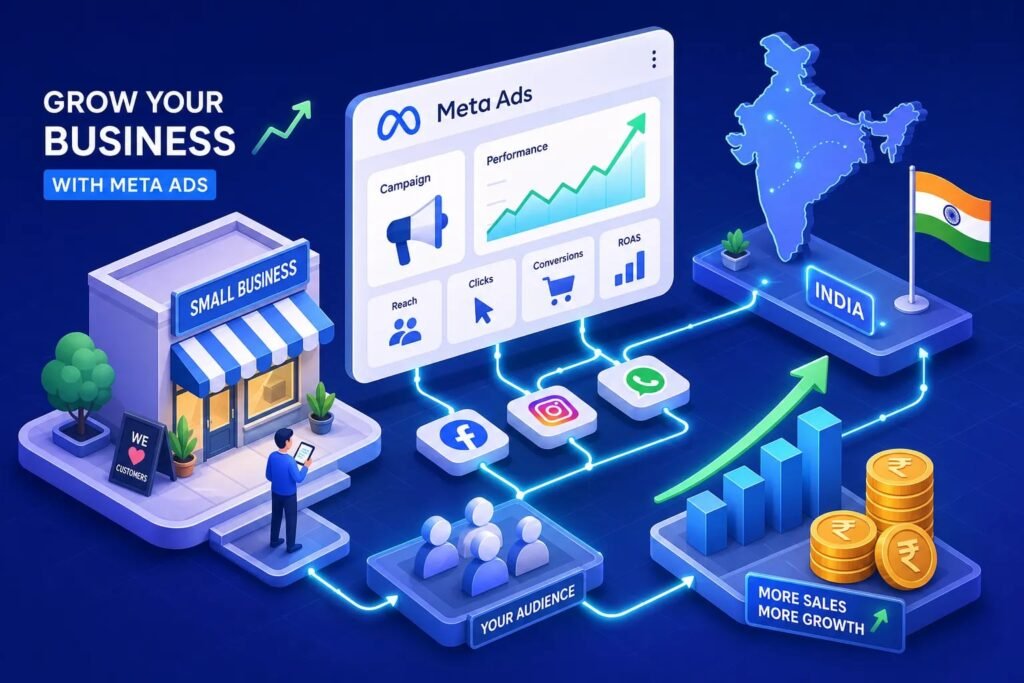
Here is a strange paradox. Walk into almost any Indian market, a boutique in Bandra, a tutoring centre in Coimbatore, a catering business in Jaipur, and you will find the owner has a Facebook Page, an Instagram profile, and a WhatsApp number printed on their visiting cards. They post occasionally, reply to comments when they remember, and tell themselves social media is “part of the plan.” Yet the moment someone mentions paid advertising, the conversation stops. Not a single rupee spent. Not a single campaign launched.
The opportunity sitting untouched is enormous. Meta’s combined reach across Facebook and Instagram in India runs into hundreds of millions of users, and the cost to reach them remains far lower than almost any other paid channel available to a small business. CPMs in India run as low as ₹50 on some placements, extraordinary access for extraordinary value. Agencies like OnlinEmage have built AI-powered systems around this same advertising infrastructure, and what they have learnt is consistent: the businesses that win are not the ones with the biggest budgets. They are the ones who understand the process.
This guide covers exactly how to run Meta ads for small business in India, from creating the Business Manager account to reading your first week of results. Just a clear sequence, explained plainly.
How to Run Meta Ads for Small Business in India: Account Setup
Most beginners skip proper account structure entirely. They boost a post from their personal profile, spend ₹500, get confused by the results, and conclude that Meta ads “don’t work.” The foundation determines everything downstream, your ability to track conversions, add team members, and recover your account if something goes wrong.
Start at business.facebook.com. Log in with your personal Facebook profile (Meta requires this as the identity layer), enter your business name, your name, and a dedicated business email. Use a business email rather than a personal Gmail address. Verify the email when Meta sends the confirmation. If Meta prompts for additional business details such as your legal name, address, and phone number, fill these in accurately. Incomplete or inconsistent information can trigger additional review steps and temporary restrictions on Indian accounts, so it pays to be thorough from the outset.
Once the portfolio is created, go to Business Settings and connect your assets in sequence. Under Accounts, add your Facebook Page, then link your Instagram professional account. Then create a new Ad Account, and here is where you must pay close attention: set the currency to INR and choose the correct Indian time zone before confirming. According to Meta’s own setup documentation, both settings are locked at creation; changing them later requires opening a new account and losing all historical data. If a team member or an agency will manage the account, assign roles through Business Settings so they have access without needing your personal login credentials.
The final setup step is installing the Meta Pixel. In plain terms, the Pixel is a small piece of code that tells Meta which actions happened on your website after someone saw your ad. It is how the algorithm learns who is actually buying, enquiring, or signing up, not just clicking. For most Indian small businesses using Shopify or WooCommerce, a partner integration is the fastest path: the official Meta for WooCommerce plugin or Shopify’s Meta sales channel connects both the Pixel and the Conversions API in a guided flow. The Conversions API is the server-side companion that continues working even when a user’s browser blocks tracking cookies. Use both together, because each fills the gaps the other misses.
Picking the Campaign Objective That Matches Your Actual Goal
The objective you choose tells Meta’s algorithm what outcome to optimise for. Choose wrong, and you pay for the wrong actions entirely. Running a Traffic campaign when your actual goal is leads is one of the most common, and most expensive, mistakes small business owners make. The algorithm will faithfully deliver clicks, but it will not specifically seek out people likely to fill a form or send a message.
The four objectives most relevant to Indian small businesses are Traffic, Leads, Messages, and Sales. Traffic drives website clicks and works well for content promotion or early audience building. Leads collects form fills, either through Facebook’s native lead forms or a tracked landing page. Messages opens conversations on WhatsApp or Messenger, a particularly powerful format given how central WhatsApp is to business communication across India. Sales tracks completed purchases or specific actions through your Pixel. Awareness campaigns have their place in brand building, but they are rarely the right starting point for a business with a tight budget that needs measurable returns quickly.
Match the objective to your actual conversion mechanism. A local salon that books appointments over WhatsApp should run Messages campaigns. An e-commerce store with the Pixel installed should run Sales campaigns. A coaching business collecting enquiries through a landing page form should run Leads campaigns. One additional consideration: Meta’s algorithm needs roughly 50 conversion events per ad set per week to exit the learning phase and optimise reliably. If your daily budget cannot generate that volume at current Indian CPAs, starting with a softer objective such as Traffic or Leads and graduating to Sales as your data builds is the smarter sequence.
How to Run Meta Ads for Small Business in India: Targeting & Budgets
India is not one market. Targeting “India” broadly on a ₹500 daily budget is one of the fastest ways to burn money on impressions from audiences who will never become your customers. Facebook Ads Manager India offers targeting tools granular enough to reach exactly the right person in the right city in the right language, using them deliberately is what separates profitable advertisers from frustrated ones.
Start with warm audiences before spending a rupee on cold prospecting. Warm audiences, people who already visited your website, watched your videos, or engaged with your Page or Instagram profile, convert better and cost less because the trust barrier is already lower. Build a website visitor custom audience using your Pixel data across 30, 60, and 90-day windows. Add an Instagram and Facebook engager audience from Business Manager. If you have a customer list from your CRM or WhatsApp contact database, upload it as a customer list custom audience. Always add exclusions to prevent wasting budget on people who are already customers or active leads.
Once warm audiences are running, use 1% lookalike audiences built from your best customers or purchasers to scale efficiently. The seed audience should have at least 100 people, though the quality of the seed matters more than its size. A lookalike built from actual purchasers will outperform one built from anyone who ever clicked your ad. Start with 1% before widening to 2, 5%, as tighter lookalikes most closely reflect your actual buyer profile.
For businesses without enough first-party data yet, detailed interest targeting with two or three closely relevant interests layered with age, gender, and location can work well for cold prospecting. Keep the test audience size between 2, 5 lakh for campaigns on modest budgets so the algorithm has enough room to find patterns without spreading spend too thin.
Locality and language targeting is one of the highest-leverage settings most small businesses ignore. For local service businesses, use city, pin-code, or radius targeting and select “people living in this location” rather than “interested in this location.” The former reaches actual residents; the latter can include tourists and travellers who will never walk through your door. For Tier 2 and Tier 3 markets, running Instagram ads for small businesses in Hindi, Tamil, Telugu, Kannada, Marathi, or Bengali rather than English is not a minor detail. English-language ads consistently underperform in these markets because the creative simply does not feel relevant to the person seeing it.
Setting a Budget That Delivers Results: India Cost Benchmarks for 2026
There is no magic number, but there is a minimum below which Meta’s algorithm cannot learn fast enough to produce results. Starting at ₹100 per day leaves the campaign data-starved and stuck in the learning phase indefinitely. The algorithm needs volume to learn, and volume requires sufficient spend.
Based on 2026 Indian benchmarks, here is a practical framework for daily budgets by objective:
- ₹200, ₹400 per day, Messages campaigns targeting local audiences
- ₹300 per day, Traffic campaigns generating roughly 50, 150 website clicks daily, depending on targeting
- ₹500 per day, the minimum where lead generation campaigns begin to optimise reliably and produce consistent lead volume
- ₹1,000 per day or more, catalogue sales and e-commerce conversion campaigns that need sufficient purchase volume to exit the learning phase
On cost benchmarks for Meta advertising in India for small business: CPMs for e-commerce and retail campaigns run approximately ₹80, ₹250. Services campaigns run wider, from ₹50 to ₹400, depending heavily on the objective and placement. CPC ranges from ₹12 to ₹22 for e-commerce and ₹8 to ₹35 across service categories. Awareness and traffic objectives sit at the cheaper end of both ranges; lead generation and purchase campaigns cost more per result but produce more direct business value. These benchmarks give you a reference point. If your cost per lead is running at 3x the benchmark for your category, the most likely causes are the creative, the targeting, or the landing page, not the budget level itself.
Creative Best Practices That Actually Work for Indian Audiences
Globally polished, studio-produced ads often underperform in India compared to authentic, locally resonant content. The best Meta creatives for Indian audiences feel less like advertisements and more like something a friend would share organically. This is not a compromise on quality, it is an understanding of how Indian users consume content on their phones.
Reels and Stories in 9:16 vertical format (1080 x 1920 pixels) are the highest-engagement placements in India, driven by how the vast majority of users consume content on mobile. The 1:1 square format (1080 x 1080) remains the most versatile option for feed placements and works across most Meta surfaces without cropping issues. Avoid repurposing landscape video into vertical placements since the cropping destroys the composition and signals immediately that the ad was an afterthought. Carousel works well for multi-product businesses and comparison-style storytelling. Collection ads work well for e-commerce at the bottom of the funnel.
For video, the first three seconds are everything. The opening frame must stop the scroll, and the strongest hooks for Indian audiences are problem-first statements delivered in Hindi or the relevant regional language. A 15 to 30-second structure works best: identify the problem or state a bold benefit in the first two to three seconds, show proof or a product demonstration in the middle, and close with one clear call to action. Keep on-image text minimal. Lead with the benefit in your copy, not the feature. In most categories tested across Indian markets, UGC-style, selfie-format video outperforms polished studio creative because it signals authenticity rather than advertising. Add vernacular subtitles to every video so the creative works with the sound off, which is how most users scroll through their feeds.
A Simple Optimisation Checklist to Measure ROI and Decide What Is Next
Launching a campaign is the beginning, not the end. Most small business owners either check results every hour, which disrupts the learning phase, or check results never, which allows weeks of wasted spend. The right rhythm is a structured weekly review with a clear set of questions.
Do not make changes in the first three to five days. The algorithm is in its learning phase and needs uninterrupted data to calibrate. After seven days, review three numbers. First, cost per result against the India benchmarks for your objective and industry. If your cost per lead is running at more than twice the benchmark, pause and test a new creative before touching the targeting. Second, frequency: if your small audience has seen your ad more than three times on average, a commonly used heuristic across Meta campaign managers, you are likely hitting ad fatigue. Expand the audience or rotate the creative. Third, click-through rate as a signal of creative health. A low CTR tells you the hook or the offer is not landing. Fix the creative before adjusting anything else.
Manual campaign management works well up to a point: one campaign, one audience, one creative. But as you scale to multiple ad sets, multiple creatives, and multiple objectives simultaneously, the number of variables a human can optimise in real time becomes unmanageable. For businesses at that inflection point, an AI-first agency like OnlinEmage is worth exploring. Their approach involves continuous budget reallocation toward better-performing ad sets, systematic creative testing, and reporting that goes beyond click counts to show actual business impact, the kind of structured oversight that is difficult to replicate manually as campaign complexity grows. If that stage sounds familiar, reach out to the OnlinEmage team to understand what an AI-powered campaign structure could look like for your business.
The Businesses That Win Are the Ones With the Clearest Process
Learning how to run Meta ads for small business in India comes down to one thing: sequence. Get the setup and tracking right before you spend. Reach warm audiences before going after cold ones. Anchor your budget in real Indian benchmarks, not figures borrowed from a foreign blog post. Build locally resonant creative before worrying about production polish. Review results weekly before thinking about scaling.
The most important shift is moving from intuition to process. Start with one campaign, one audience, one creative, and let the data guide every decision after that. As the campaigns grow and the variables multiply, the gap between businesses with the right systems and those without becomes the gap between compounding growth and compounding frustration. The process is the advantage, protect it.
