
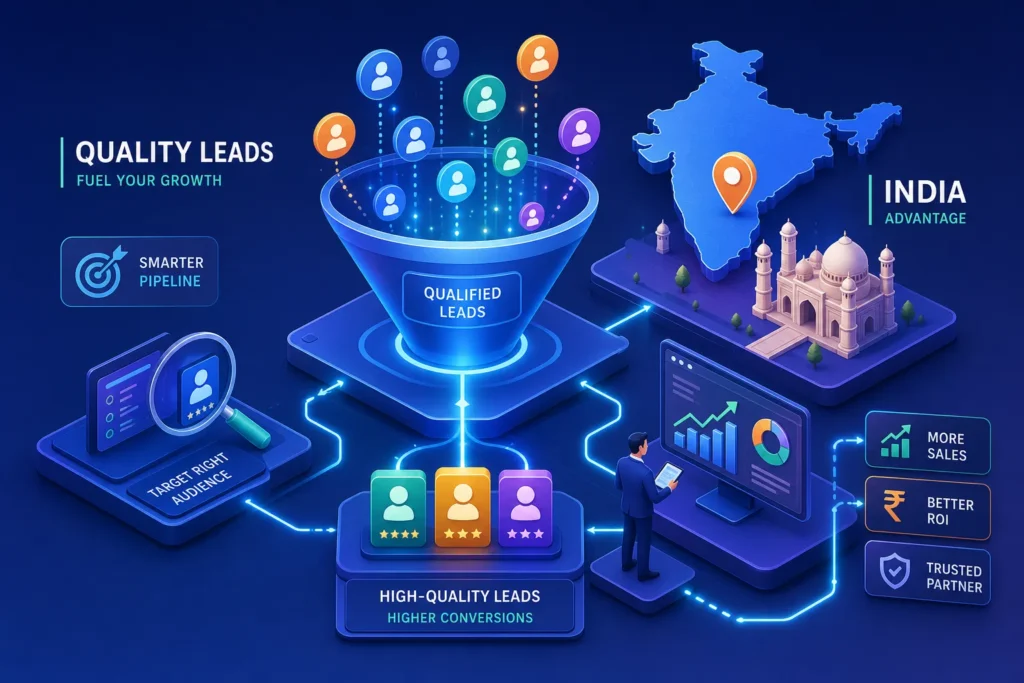
The Indian lead generation services market has a dirty secret that most agencies would rather you never discovered. Many low-cost vendors selling “lead generation” are, in reality, offering contact harvesting: spreadsheets of email addresses, LinkedIn profiles, and phone numbers dressed up with a few intent signals and handed over as if pipeline materialises by magic. Businesses sign retainers expecting qualified appointments, confirmed budgets, and warm conversations. What they receive, more often than not, fails to progress beyond the first outreach.
Here is the central paradox worth sitting with before you evaluate a single proposal: the cheaper the service looks upfront, the more expensive the outcome tends to be downstream. Consider this illustrative comparison, a ₹1,00,000-per-month retainer that delivers twenty genuinely qualified conversations against a ₹40,000 arrangement that floods your CRM with two hundred contacts your sales team must individually disqualify. Wasted sales bandwidth is a revenue problem. It just does not show up on the marketing invoice.
A new generation of AI-first agencies, including OnlinEmage, has fundamentally changed what outsourced lead generation services can deliver. The shift is not cosmetic. AI-powered systems score prospects by buying intent, segment audiences by behavioural stage, and nurture automatically until a prospect is genuinely ready to talk. This guide will give you the framework to evaluate any provider: the questions to ask, the benchmarks to demand, and the structure for a 60, 90 day pilot that proves value before you commit to anything long-term.
Why most lead generation services sell contacts, not pipeline
Traditional outsourced lead generation follows a recognisable playbook. A small SDR team sends cold emails and LinkedIn connection requests at volume, logs responses in a basic CRM, and reports weekly on “leads touched.” For certain verticals with short sales cycles and low deal complexity, this model still works adequately. For most mid-market and enterprise B2B lead generation scenarios, it often struggles to scale. The output quality depends entirely on the human doing the research, and human research capacity is finite, inconsistent, and expensive to expand.
The hidden cost of this approach appears in your sales team’s calendar. A sales representative spending a significant portion of their time disqualifying unfit contacts is not experiencing a process inconvenience; they are experiencing a revenue problem. Across most B2B sectors, the majority of new leads do not convert without structured nurturing, and only a small fraction become sales-ready without active qualification. If your agency is handing you raw contacts rather than qualified pipeline, you are essentially employing your sales team as research assistants. That is neither efficient nor sustainable.
How AI-powered lead generation services change the economics
The traditional SDR model’s limitations have opened the door to a fundamentally different approach. AI-first lead generation agencies have rebuilt the entire pipeline-building process around predictive intelligence, adaptive nurturing, and real-time optimisation, delivering outcomes that outsourced SDR arrangements structurally cannot match. For an overview of the AI tools and strategies that power these systems, see AI in Digital Marketing: Top Tools & Strategies to Succeed.
Predictive scoring: finding buyers before they raise their hand
AI-driven lead generation uses predictive scoring to rank prospects by their likelihood to buy, drawing on signals most human researchers would never catch at scale. Behavioural data, technographic fit, hiring activity, content consumption patterns, and intent keyword signals are weighted continuously by machine learning models that recalibrate based on actual closed deals. The system assigns a probability score, typically from 0 to 100, and surfaces accounts showing accelerating interest rather than casual browsing. Contrast this with manual research, which relies on static ideal customer profile (ICP) lists and gut instinct, and the gap in output quality becomes self-evident.
Intent data is particularly powerful for B2B lead generation services in India across SaaS, technology, and enterprise services. When a prospect is already researching a solution across publisher networks, reading competitor comparisons, and visiting pricing pages, they are not a cold lead at all. They are a warm one who has not yet raised their hand to any vendor. Identifying and engaging them at this moment is consistently the highest-quality channel available for outbound B2B campaigns.
Smart segmentation and automated nurturing
AI layers smart audience segmentation on top of scoring. Prospects are grouped by behaviour and buying stage, then entered into automated multi-channel sequences that adapt based on engagement signals. A prospect who opens three emails but never replies receives a different next touchpoint than one who clicked a case study and visited a product page. This adaptive logic is what separates intelligent demand generation from the broadcast model of traditional outsourced SDR teams. OnlinEmage is built on precisely this architecture: predictive analytics, automated multi-channel nurturing, and real-time campaign optimisation working as an integrated system rather than a collection of disconnected tools. For agencies that also provide focused content work to fuel these sequences, see AI Content Creation & Strategy Services | OnlinEmage.
Five questions that expose a weak provider before you sign
How do they define a “qualified” lead?
A reputable lead qualification service defines a qualified appointment by four criteria: ICP match, verified contact data, confirmed buying need, and demonstrated budget. Ask whether the provider uses a validation process that layers AI intent data with manual verification, and whether they guarantee refunds for bounced or inaccurate data. The industry standard for email accuracy is 95%, with refund clauses for contacts that fall below that threshold. Providers who cannot answer this question precisely are selling volume, not quality.
What SLAs do they actually put in writing?
The benchmarks worth demanding in writing include a defined minimum volume commitment, first lead delivered within seven days of campaign launch, and real-time reporting on open rates, reply rates, meetings booked, and show rates. Bear in mind that reputable lead generation agencies vary in how they structure volume guarantees, some advertise a fixed number of appointments per period, while others define qualification criteria and activity-based commitments rather than raw lead counts. Either way, the qualification standards must be in writing. Client retention rates of 80, 85% year-over-year are one of the most reliable proxies for service quality in this industry. Ask providers for references directly and verify retention rather than accepting testimonials from a case studies page. For a compact checklist of lead management SLA best practices, use that as a baseline when negotiating written guarantees.
What does their reporting dashboard actually show?
There is a clear line between lead generation agencies that track activity and those that track outcomes. Activity metrics cover emails sent, connection requests made, and dials completed. Outcome metrics tell the real story: cost per qualified lead (CPQL) reduction, MQL volume growth, SQL conversion rate, and pipeline influenced. The first category tells you whether people showed up to work. The second tells you whether your investment is producing revenue. Demand outcome-linked reporting from any provider you seriously consider, and walk away from proposals that lead with vanity figures.
Pricing decoded: what lead generation services actually cost in India in 2026
The three main pricing models
Buyers in India will encounter three primary pricing structures when evaluating outsourced lead generation services. Monthly retainers for outsourced SDR arrangements typically fall between ₹83,000 and ₹6,65,000 per month, with the lower end covering shared SDRs or AI-assisted outreach and the upper end covering dedicated pods with multichannel coordination. Pay-per-lead pricing ranges from ₹2,000 to ₹12,500 per qualified lead, depending on industry complexity. Pay-per-appointment models sit between ₹8,300 and ₹33,000 per appointment. Indian agency rates remain roughly 30, 50% below equivalent US or European pricing for comparable mid-market quality, which represents a genuine cost advantage for domestic buyers. For comparative market rates and published lead generation pricing frameworks, review independent pricing studies before you evaluate proposals.
What low pricing actually signals
Cost-per-lead benchmarks vary meaningfully by sector. SMB and commercial services typically fall between ₹2,000 and ₹5,000 per lead. Enterprise and financial services sit between ₹3,300 and ₹10,000. Regulated sectors such as healthcare IT and enterprise technology range from ₹6,600 to ₹12,500. Any pay-per-lead companies offering proposals below ₹2,000 should prompt immediate scrutiny: at that price point, the data is almost always recycled, scraped from public directories, or shared across multiple clients simultaneously. The lowest-cost option reliably costs more in sales team time than a mid-tier retainer with tighter qualification standards. This is not a heuristic. It is the arithmetic of wasted sales bandwidth.
The conversion benchmarks every buyer must demand
What “good” looks like at each funnel stage
Hold any provider accountable to these benchmarks before you sign anything. Lead-to-MQL conversion should fall between 20, 30%. MQL-to-SQL conversion: the 2026 industry median sits at roughly 9, 10%, but campaigns running with tight ICP definitions typically achieve 15, 20%, and those applying behavioural scoring can reach 30, 40%. SQL-to-opportunity should be 30, 40%, and opportunity-to-close should reach 25% or better for professional services. As a reference point, professional services as a sector achieves a 9.3% overall lead-to-sale rate, significantly above most B2B technology averages. Providers who cannot articulate where your campaign will target within these ranges are not measuring the things that matter. For published B2B lead benchmarks and digital marketing conversion data, compare vendor claims against industry studies before you sign.
The ROI multipliers worth building into your SLAs
Agencies integrating lead scoring, data enrichment, and structured nurturing sequences consistently deliver measurably superior economics. Research from Marketo indicates that lead scoring alone can produce substantially higher ROI than campaigns running without it. Disciplined nurturing programmes, according to similar industry research, yield significantly more sales-ready leads at lower cost per acquisition. These are the outcomes of building qualification and nurturing into the contract as requirements rather than optional add-ons. Buyers who bake these requirements into their SLA get fundamentally better economics from the same budget than buyers who leave them to the provider’s discretion. If improving conversion rates is a priority, also review specialist guidance on AI-Driven Conversion Rate Optimisation | More Leads to ensure landing pages and funnels are optimised for the higher-intent traffic your vendor will send.
How to run a 60-90 day pilot with real confidence
Building your pilot brief
A well-structured pilot brief contains five elements: a clearly documented ideal customer profile with specific firmographic and behavioural criteria, agreed qualification standards in writing, three to five KPIs measured weekly (CPQL, MQL volume, SQL conversion rate, meetings booked, and show rate), a defined escalation clause if minimum guarantees are not met by day 30, and a 30-day notice exit option rather than a long lock-in. Requesting raw lead samples during the pitch process, rather than curated case studies, is the fastest way to separate credible lead-gen companies from volume vendors. Real data reveals data quality. Polished decks do not.
During the pilot, track tactical metrics weekly: cold email reply rates (benchmark: 5, 10%), meeting booking rates, and speed-to-lead response times. Speed-to-lead matters more than most buyers realise, research consistently shows that contact rates drop sharply when response time exceeds five minutes after a lead’s first signal of intent. Track strategic metrics monthly: cost per qualified lead, MQL-to-SQL conversion, and pipeline value generated. The distinction between weekly and monthly reporting cadences matters because it prevents tactical noise from obscuring strategic signal, and vice versa.
Why OnlinEmage deserves to be your first call
OnlinEmage is the natural starting point for any serious shortlist. As an AI-first digital marketing agency, OnlinEmage delivers lead generation services not as a bolt-on service but as an integrated system: predictive audience targeting, automated multi-channel nurturing, and real-time campaign optimisation working together for B2B and B2C brands from a single operational backbone. Before signing with any traditional outsourced lead generation provider, benchmarking their offering against what an AI-driven agency can deliver will sharpen your expectations considerably and raise the floor of what you are willing to accept. If you need practical guidance on choosing an agency partner, consider vendor selection checklists and agency evaluation resources to avoid common pitfalls.
The distinction that determines your pipeline
Lead generation services in India have never been more varied in quality, and that variation is nearly impossible to see from the outside without the right evaluation framework. Surface-level signals such as logo-heavy case studies, promising CPL figures, and enthusiastic sales calls tell you almost nothing about whether a provider will deliver pipeline or spreadsheets.
You now have five levers that change this calculus: a precise definition of what “qualified” actually means, pricing benchmarks to sanity-check every proposal, conversion rates to hold providers accountable at each funnel stage, a channel strategy matched to your industry, and a 60, 90 day pilot structure that limits your downside risk while proving value quickly. For a snapshot of the most effective channels for B2B lead generation in 2026, use that insight to prioritise vendor capabilities rather than asking vendors to be “good at everything.”
The best decision when choosing B2B lead generation services is not about finding the cheapest agency or the one with the biggest name on their client list. It is about finding a partner who connects intelligent targeting to automated nurturing and delivers a genuine sales pipeline rather than a contact list. That distinction is exactly what separates AI-powered demand generation from everything that came before it, and it is the standard every provider you consider should be held to from the first conversation.
