
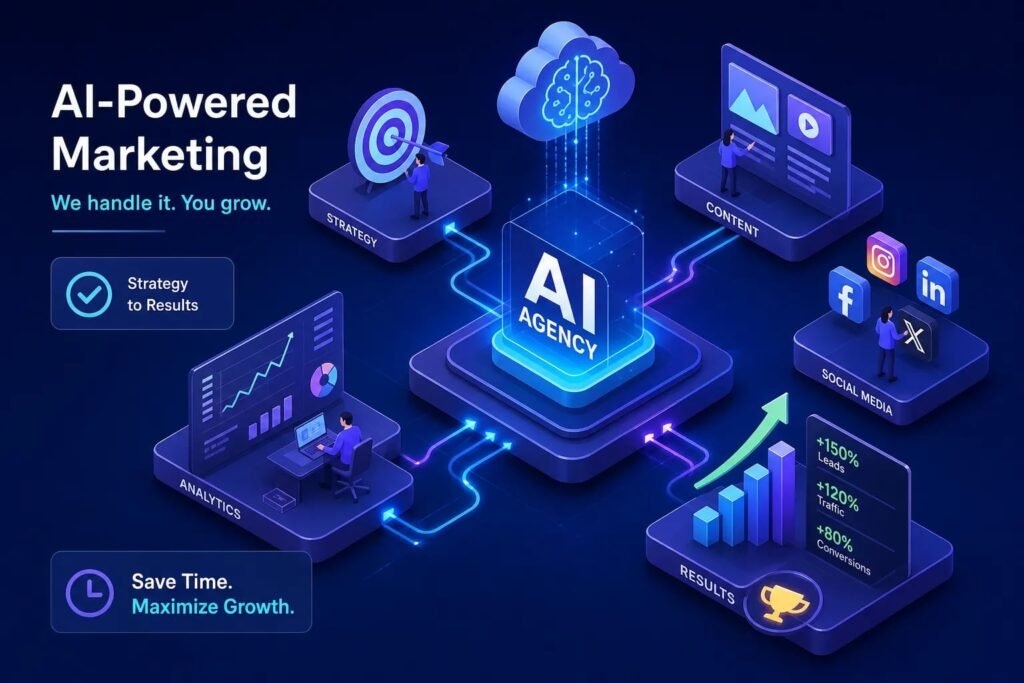
Deciding to outsource marketing to an AI agency is one of the more consequential strategic choices a founder can make, and one of the most frequently underestimated. Here is a counterintuitive truth: the businesses that guard marketing control most fiercely are often the ones spending the most and growing the slowest. Founders who insist on keeping everything in-house tend to frame it as a strategic choice. In practice, it frequently becomes a capacity trap, where the business is too busy managing the marketing function to actually improve it. The real question is not whether you can handle marketing internally. The real question is whether doing so is the smartest deployment of your capital and your leadership attention.
This guide walks through when it makes strategic sense to outsource your marketing to an AI-powered agency, what that decision genuinely costs and saves, and how to choose a partner that compounds results rather than simply burning your retainer. By the end, you will have a clear framework to decide, evaluate, and onboard without second-guessing yourself six months later.
The true cost of keeping marketing in-house
Most founders calculate their in-house marketing costs as salaries plus ad spend. That number misses a significant layer of operational overhead that quietly inflates the real monthly figure. Tools and subscriptions, training costs, recruitment cycles, and freelancer fees for gaps the team cannot fill all contribute to a number that rarely appears on the payroll sheet but absolutely appears on the P&L. Add to that the leadership hours spent managing rather than deciding, and the real monthly figure climbs well above what payroll alone suggests.
Consider a practical 2026 benchmark for a small in-house team in India. A marketing manager costs ₹60,000 to ₹1,20,000 per month. An SEO and content specialist adds ₹40,000 to ₹70,000. A graphic designer runs ₹35,000 to ₹60,000. Then add tools and software at ₹30,000 to ₹50,000, office overhead at ₹15,000 to ₹30,000, and amortised recruitment costs at ₹20,000 to ₹40,000. A lean three-person team routinely costs ₹2,00,000 to ₹3,70,000 per month before a single rupee goes into media spend. That is the baseline, not the full picture.
The deeper problem is capability gaps. A mid-sized in-house team rarely has a genuine expert in every channel simultaneously. You might have a solid content person but a weak paid media operator, or an SEO hire with no real experience in conversion rate optimisation. These gaps produce uneven results across channels and force you to either hire again or accept underperformance in areas that directly affect revenue. Neither option is free, and neither option is fast.
When to outsource marketing to an AI agency: three signals
Certain patterns show up consistently before businesses decide to hand their marketing to an AI-driven agency. Leading with the most telling one: a widening gap between what competitors are doing with AI-driven targeting and what your team is actually equipped to execute. This signal is the most consequential because it widens every month. When a competitor runs always-on refinement across audience segments and creative while your team manually reviews campaigns on a weekly cadence, catching up becomes progressively harder.
The second signal is stagnant campaign performance despite increasing budgets. When adding spend stops moving the needle, the problem is almost never the budget itself; it is the system managing that budget. The third signal is a marketing team that is always reactive and never strategic. If your team spends most of its time executing rather than planning, you are running a production house disguised as a marketing function.
What outsourcing actually unlocks is not the absence of control, it is a different kind of control. You shift from a fixed-cost, limited-capability model to a variable, high-capability one. A full-service AI agency brings an operational stack, real-time optimisation, and team depth that a five-person in-house unit cannot replicate, particularly when AI is embedded into every layer of the campaign rather than bolted on as an afterthought.
What actually changes when you move to an AI agency: a real cost comparison
To illustrate the structural shift, consider a hypothetical D2C brand spending ₹3.80 lakh per month in-house: ₹1.80 lakh in salaries for a three-person team, ₹0.60 lakh in tools, ₹0.80 lakh in freelancer costs for design and content, and ₹0.60 lakh in wasted ad spend from campaigns that were never properly optimised. After outsourcing to a full-service AI agency on a ₹1.50 lakh monthly retainer, the brand redirects ₹1.20 lakh entirely into media spend, eliminates freelancer dependency, and, based on outcomes reported in agency case study roundups, can realistically target a cost-per-lead reduction of 25% to 40% within the first 90 days. The arithmetic will not be identical in every situation, but the structural logic holds across categories: lower fixed overhead, higher media efficiency, and specialist depth without additional headcount.
The real ROI gains do not come only from cutting salary overhead. They come from the effect of having AI-native tools running live budget reallocation on audiences, creative, bids, and content simultaneously. Every rupee of ad spend works harder when a predictive system is adjusting targeting in real time rather than waiting for a Monday morning review meeting. Published case study roundups covering AI-powered agency deployments, including compilations by firms such as Supalabs, SimpleTiger, and Hashmeta, document outcomes ranging from 30% to 353% ROI improvement, CAC reductions of 25% to 40%, and conversion lifts of 14% to 156% across categories. It is worth noting that these figures span a wide range and that results vary significantly by vendor, methodology, and client context. What they do confirm is that well-structured, system-level campaign management consistently outperforms manual weekly optimisation.
What a full-service AI marketing agency should actually deliver
A credible AI-first agency delivers far more than content generation and ad management. The minimum viable service stack should include AI-driven SEO, paid media optimisation across Google and Meta, marketing automation, conversion rate optimisation, analytics and attribution, and creative production, all running as an integrated system rather than isolated campaigns that happen to share a client name. OnlinEmage, for instance, is structured as an AI-first growth partner rather than a traditional service vendor, with predictive analytics and automated optimisation built into its channel delivery from the outset. That structural approach is what separates a high-output retainer from a mediocre one.
The operational difference between an AI-first agency and a traditional one comes down to speed and continuity. A traditional agency optimises campaigns weekly or fortnightly. An AI-first agency runs continuous experiments, reallocates budgets in real time, and surfaces actionable audience insights without waiting for a scheduled call. That operational velocity is genuinely difficult to replicate internally unless you are building a substantial data science and marketing technology function in-house, which, for most SMBs and D2C brands, is neither feasible nor sensible.
How to outsource marketing to an AI agency: vendor checklist
Evaluating agencies requires going well beyond the pitch deck. Ask for the named tools in their tech stack and the specific role each tool plays in the workflow. Ask for case studies that include a documented baseline, a specific metric, a defined timeframe, and a business outcome, not just a client testimonial with a logo. Confirm which senior person will own your account and who the decision-maker is when something needs to change quickly. Any agency that cannot walk you through its workflow tool-by-tool is signalling that it is not ready to be your growth partner.
The most common red flags are vague AI claims without a named workflow, junior-only account teams, and reporting that tracks impressions rather than pipeline or revenue. Beyond red flags, there are data risks that demand explicit attention before any work begins. Clarify where your customer data is stored, whether it is used to train any AI models, and what happens to it contractually at the end of the engagement. Ask which subprocessors the agency uses and what data processing agreements govern their access. These are not administrative details. They are risk controls that protect your customers, your competitive position, and your legal standing. Any agency that responds to these questions with “it’s secure” but cannot give you specifics is not ready for your data.
The vendor checklist before you sign anything should cover five areas:
- Tech stack transparency: named tools with a defined role for each one
- Data policy: storage location, processing rules, retention limits, and model-training restrictions in writing
- Human oversight: a named senior strategist who reviews and approves before anything goes live
- Proof of outcomes: case studies tied to revenue, CAC, or ROAS, not just traffic
- SLA and checkpoint clause: written response times, reporting cadence, and a defined 90-day review point
Onboarding, KPIs, and defining success before campaigns go live
A poor onboarding process is the most common reason a good agency relationship underperforms in the first quarter. The first 30 days should cover a baseline audit of all existing channels, attribution setup and tracking confirmation, KPI alignment with documented benchmarks, and a content and campaign calendar. Nothing should go live before the measurement framework is in place. Without a baseline, you cannot prove improvement, and without proof of improvement, you cannot make confident decisions about where to scale.
Baseline audit and KPI contract
Before any campaigns launch, agree on the specific metrics that define success. For paid media, these should include cost per lead or cost per acquisition, return on ad spend, impression share, and experiment success rate. For organic, include keyword ranking trajectory and non-brand organic click growth. For content, define publish velocity and average time-to-rank. Separating these by channel makes the review conversation at day 90 far more productive than trying to read a single blended dashboard.
SLA and checkpoint
Alongside KPIs, negotiate a written SLA that covers response times, approval turnarounds, reporting frequency, and a checkpoint clause. A checkpoint clause is a defined moment, usually at 90 days, where both parties review performance against agreed benchmarks and decide explicitly how to proceed. Agencies that resist a checkpoint clause are communicating something important about how they handle accountability. By days 61 to 90, the focus should shift from setup to scaling: reviewing what the data shows, tightening audience targeting, refining creative, and aligning on the next-quarter roadmap. A well-structured onboarding does not just start the engagement; it establishes the operating rhythm for the entire partnership.
The decision is about leverage, not outsourcing
The businesses that grow fastest are not those with the largest in-house teams. They are the ones that deploy their capital against the highest-efficiency systems available. AI-first agencies have genuinely changed what that system looks like: faster experiments, smarter targeting, real-time campaign adjustment, and a service depth that scales without adding headcount or subscriptions. The question is not whether an AI agency can deliver better results than your current setup. For most growing businesses, the evidence points fairly clearly to the conclusion that it can. The real question is whether you are ready to run the honest cost comparison, define the right success metrics, and choose a partner with the rigour those metrics deserve.
If the signals in this guide are ones you recognise in your own business, the next step is straightforward. Build your vendor checklist, run the cost comparison with accurate numbers rather than optimistic ones, and evaluate two or three agencies, including OnlinEmage, against the criteria above. If you decide to outsource marketing to an AI agency, use the checklist here as your baseline and run a strict cost comparison using your actual monthly figures. An initial conversation often reveals whether you are speaking to a vendor or a genuine growth partner, and the questions in this guide give you everything you need to make that call with confidence.
